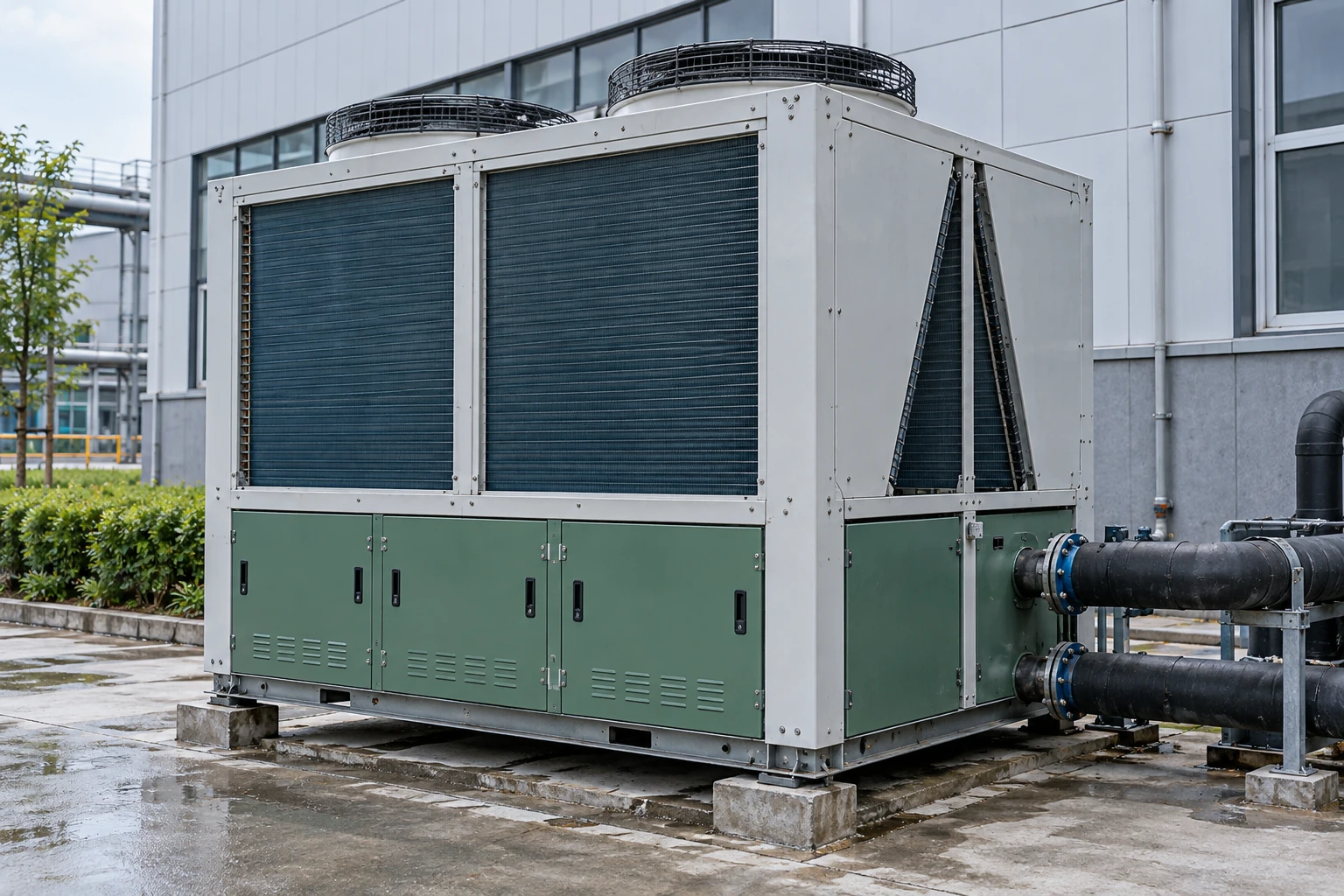
Air-to-Water Heat Pumps
air to water heat pump for cooling
| Brand | shengtongJH |
|---|---|
| Equipment selection | Reversible industrial air-to-water package with documented cooling duty |
| Nominal cooling classes | Approximately 20 / 40 / 65 / 90 kW configurations |
| Cooling comparison basis | Entering/leaving water 12/7°C; outdoor air 35°C; water as operating fluid |
| Typical cooling input classes | Around 7 / 13 / 22 / 31 kW respectively at the stated comparison basis; selected-unit data governs |
| Water-temperature options | 7–15°C supply selections for compatible loads; warmer or low-temperature duties assessed separately |
| Envelope options, W × D × H (mm) | Compact frame around 1,750 × 850 × 1,900; larger frame around 2,900–3,500 × 850–1,200 × 1,900–2,250 |
| Supply | Three-phase industrial power, selected for destination voltage/frequency |
| Water-side equipment | Pump, flow protection, buffer where required and vapour-sealed insulation |
| Load-side equipment | Cooling-rated coils or process heat exchangers; condensate collection where required |
| Controls | Cooling enable, water-temperature control, flow interlocks and process/zone permissives |
Cooling figures are common selection classes at the stated conditions. Do not use heating capacity as cooling output; glycol and different temperatures require a revised selection.
Cooling duty, water temperature, circulation and load-side interfaces can be customized for your industrial or commercial application.
An air to water heat pump for cooling must be a model designed for reversible operation. In cooling mode it removes heat from the circulating water and rejects that heat outdoors, supplying compatible fan coils, air handlers or process heat exchangers.
Check what happens at the cooled surface
Cold water alone does not make a heating-only distribution system suitable for cooling. Surfaces below the surrounding air's dew point collect condensation. Fan coils and air handlers need suitable drain pans and drainage; cold pipes, valves and fittings need continuous insulation with an effective vapour barrier.
Radiant cooling surfaces require dew-point control and a separate plan for humidity management. They should not be treated as a substitute for dehumidification merely because the water is cold.
Choose the supply temperature from the load
A process heat exchanger may work with relatively warm cooling water, whereas an air-handling coil intended to remove moisture may require a colder supply. Select the highest temperature that still meets the actual process and humidity duty, then check coil output and water flow at that condition.
Lowering the setpoint without reviewing the system can create condensation, increase electrical demand and move the unit outside its intended envelope. Sub-zero fluid duty requires compatible equipment and an appropriate fluid mixture; ordinary water-cooling settings should not be extended arbitrarily.
Summer intake air matters
Heat rejected by the outdoor coil must escape. Walls, screens and neighbouring machines can return warm discharge air to the intake, reducing useful cooling. Select against the temperature at the planned intake, including local heat sources.
Keep flow as zones close
Closing cooling valves changes circulation. Preserve the unit's minimum flow through an appropriate hydraulic arrangement and provide enough active water volume for reduced-load operation. A running pump signal alone does not prove adequate evaporator flow.
Cooling mode needs its own commissioning
Check condensate drainage, insulation continuity, water flow and terminal-unit control before regular operation. Verify that heating controls cannot inadvertently request hot water while the shared loop is serving a cooling demand. Seasonal changeover should be an agreed control sequence, not a manual guess at the controller.
When cooling is the only requirement
If the process never needs heat, compare a dedicated air-cooled chiller with a reversible package. The useful comparison includes actual duty, minimum-load behaviour, maintenance and purchase scope rather than assuming that additional operating modes always improve the project.
Cooling duty, water temperature, circulation and load-side interfaces can be customized for your industrial or commercial application.