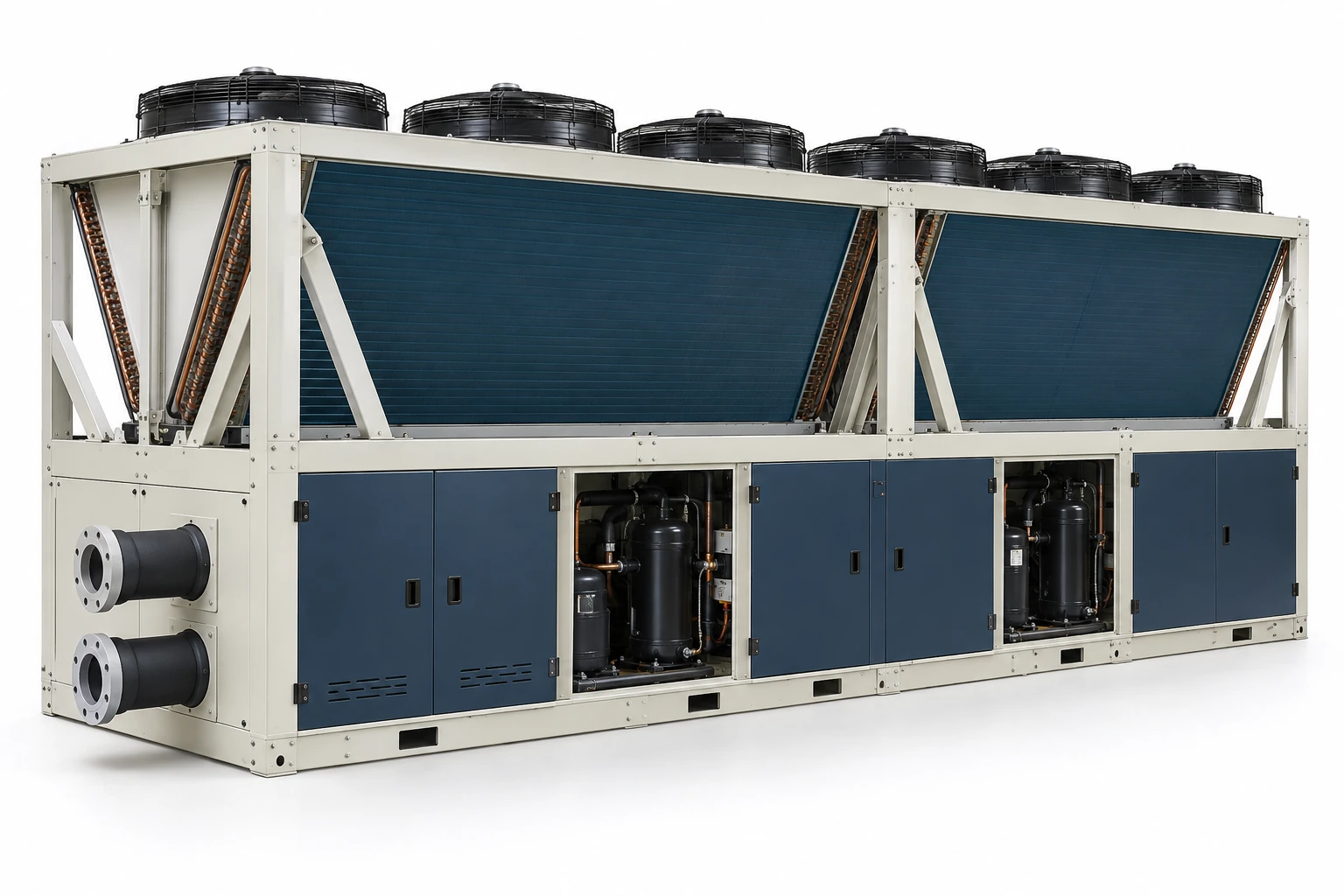
Air-to-Water Heat Pumps
air to water heat pump chiller
| Brand | shengtongJH |
|---|---|
| Equipment type | Industrial reversible air-cooled heat-pump chiller |
| Capacity classes | Approximately 65 / 110 kW modules and larger central configurations |
| Operating modes | Heating or cooling on a standard two-pipe unit; simultaneous-duty plant selected separately |
| Cooling selection condition | Water 12/7°C entering/leaving and outdoor air 35°C for comparison |
| Heating selection condition | Water 40/45°C entering/leaving and outdoor air 7°C for comparison; winter duty additionally checked |
| Electrical input | Separate heating/cooling input and auxiliary loads stated with selection |
| Envelope options, W × D × H (mm) | Modules around 2,300 × 1,150 × 2,250; larger central frames around 5,000–7,000 × 2,300 × 2,250 |
| Water connections | Single reversible loop or engineered separate distribution; pump duty matched in each mode |
| Capacity control | Inverter, compressor staging or coordinated modules depending on package |
| Plant interfaces | Mode selection, flow proving, remote alarm, sequencing and compatible communications |
Heating and cooling capacities are not interchangeable. A reversible two-pipe package is not automatically a simultaneous heat-recovery chiller.
The equipment arrangement, mode strategy, hydraulic plant and control interfaces can be customized to your heating and cooling duties.
An air to water heat pump chiller combines chilled-water operation with a heating mode in a suitable reversible package. It can reduce the need for separate seasonal equipment where the load profile, water temperatures and operating schedule are compatible.
Reversible operation and heat recovery are different
In a standard reversible unit, the refrigeration circuit changes which heat exchanger absorbs heat and which rejects it. The water circuit is therefore supplied with either chilled or heated water. A conventional two-pipe unit cannot provide both through that same circuit at the same time.
A heat-recovery or multi-pipe arrangement has a different purpose: it can use suitable concurrent heating and cooling demand rather than simply switching seasonally. The required equipment, controls and distribution must be selected for that task. A four-pipe building network by itself does not turn an ordinary two-pipe machine into a heat-recovery unit.
Look for compatible operating schedules
A facility that needs heating in winter and cooling in summer may suit a changeover arrangement. A production process needing year-round cooling while another area needs heat requires a different plant strategy. Map simultaneous demand before combining equipment.
Select both design points
Heating performance at a mild outdoor condition does not prove winter output, and the heating nameplate does not establish summer cooling capacity. Obtain separate duty selections using the actual water temperatures, ambient conditions and fluid.
One water network must tolerate both modes
Check pipe insulation, expansion provision, terminal equipment and allowable temperatures. Cooling introduces condensation risks that a heating-only installation may never have faced. Heating introduces thermal expansion and different operating conditions. Confirm pump performance and unit flow limits in each mode.
Make changeover deliberate
The controller should coordinate the mode request, valve positions, circulation and permitted restart. Allow the distribution system to reach the required condition before enabling sensitive loads. Avoid frequent switching caused by conflicting local requests.
During heating, defrost can temporarily alter water-side demand. Maintain the selected water volume and flow, provide drainage and agree how supplementary capacity responds if fitted. During cooling, verify condensate handling and low-load stability.
Choose the plant that fits the useful hours
Compare a reversible package with separate heating and cooling equipment using the actual annual load profile. Consider maintenance outages, essential process loads and the ability to operate one mode while another unit is serviced. shengtongJH can coordinate the chosen package and supporting equipment around that operating brief.
The equipment arrangement, mode strategy, hydraulic plant and control interfaces can be customized to your heating and cooling duties.