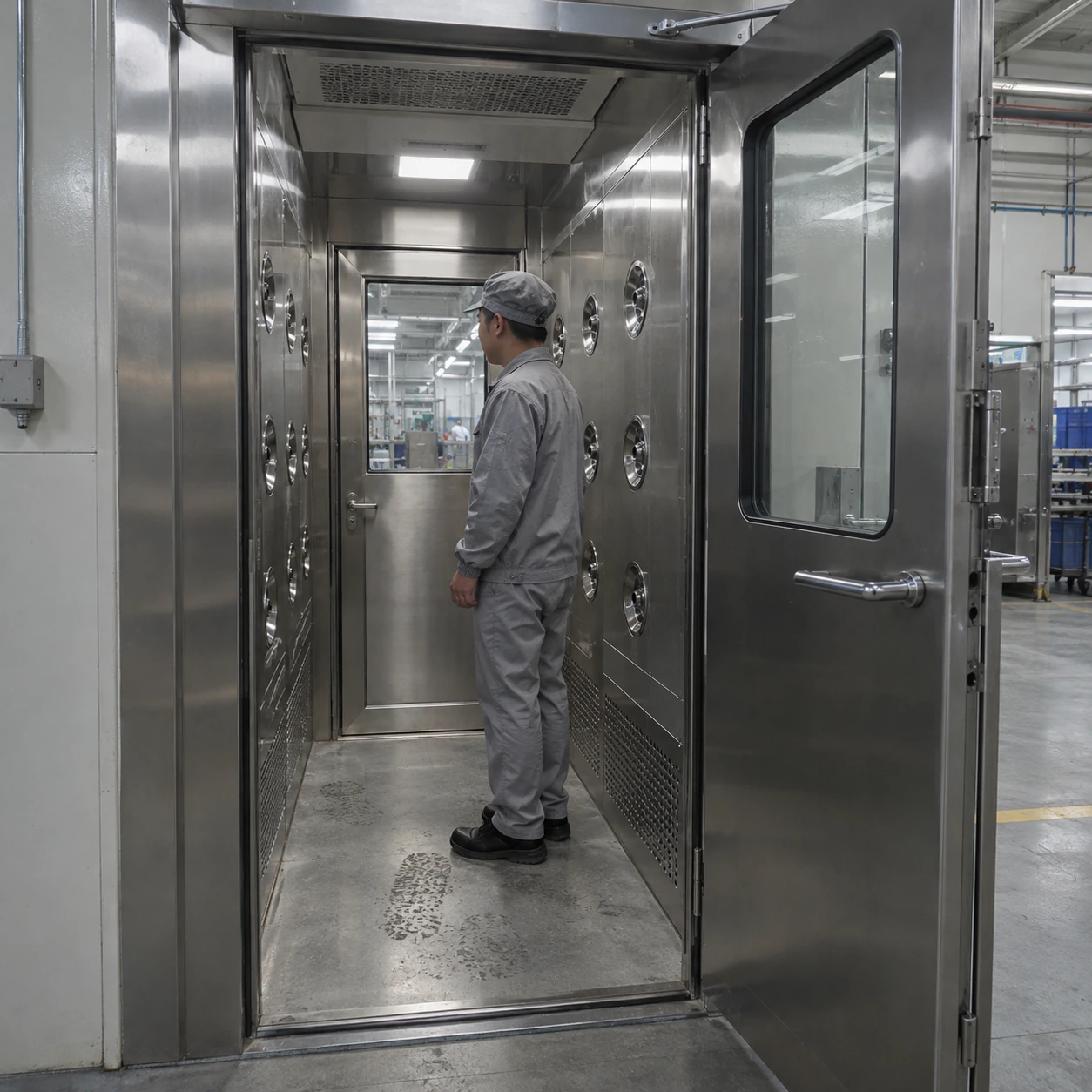
decontamination air shower
Product specifications
| Spec | Configuration |
|---|---|
| Removal method | Enclosed dry particle-removal air shower for suitable exposed garment surfaces. |
| External planning options | Individual entry: 1400 × 1000 × 2100 mm Additional standing depth: 1400 × 1500 × 2100 mm Extended arrangement: 1400 × 2000 × 2100 mm W × D × H reference layouts; final dimensions follow the approved configuration drawing. |
| Occupied clearance | Internal clear width and door opening selected for the protective clothing and required movements; both remain separate from the external dimensions. |
| Interior material | Cleanable stainless panels with accessible joints, seals and removable return covers. |
| Jet coverage | Opposing-side adjustable nozzles with positions suited to the exposed garment surfaces. |
| Filter arrangement | Accessible prefilter and documented HEPA final filter for the selected non-hazardous particle duty. |
| Cycle and doors | Adjustable duration, closed-door sensing, interlock and visible completion indication. |
| Cleaning provisions | Cleaning chemistry matched to panels, glazing, seals and hardware; accessible collection areas. |
| Application boundary | Hazardous exit contamination requires a separately assessed containment and filter-handling arrangement. |
The chamber and handling provisions can be configured for the installation space and assessed contamination-removal application.
Define the contamination first. Loose surface dust, chemical residue and biological contamination require different treatments.
What the air can remove.
A decontamination air shower can be considered for dislodging loose particles from the outside of clothing or from suitable object surfaces. Jets act mechanically: they disturb deposited particles, while the return and filtration arrangement manages the resulting airborne dust. This is a dry particle-removal step.
A particle filter does not neutralize chemicals or make a garment sterile. Bonded residue, oil films and contamination inside a package are outside this mechanism. If those are the problem, cleaning, packaging removal, disinfection or a separately engineered containment procedure may be the appropriate step.
Entry dust and hazardous exit contamination are different projects.
Protecting a clean production area
For ordinary non-hazardous dust on garments, the objective is to reduce carry-in at the entry boundary. Clean clothing, footwear control and a disciplined route still do much of the work. Inspect pockets, garment folds and areas shadowed by the user's stance.
Leaving a contaminated process
Where dust may be toxic, sensitizing or biologically hazardous, blowing it off can create an exposure problem for the wearer and anyone who services the unit. A conventional entrance shower must not be repurposed on the strength of the word “decontamination.” Evaluate containment, exhaust treatment, personal protection and filter-change handling through the site's specialist risk assessment.
Design the collection step with the removal step.
Return grilles need unobstructed access to the chamber air. Loose items should not be carried into the shower where jets can lift them. A cleaning procedure should remove settled material without pushing it into inaccessible joints. If filter maintenance exposes captured contamination, the handling procedure is part of the equipment specification.
Agree a practical acceptance method for the actual garment or object and contamination type. A filter label or high nozzle reading alone does not demonstrate the required surface-removal result.
Space for the intended procedure
Configuration planning examples are 1400 × 1000 × 2100 mm external W × D × H for an individual entry step, 1400 × 2000 × 2100 mm for additional standing depth, and 2300 × 2000 × 2200 mm for a wider reviewed arrangement. Internal clear width and door opening must accommodate the protective clothing and movements involved. These dimensions are planning options, not a containment rating.
Understand particle filtration ↗Configuration for the identified contamination
For a conventional non-hazardous entry application, options include opposing-side jets, a documented HEPA final filter, an accessible prefilter and adjustable duration. Smooth stainless interior panels and removable grille covers can support a defined cleaning method. The selected cleaning chemicals must also suit seals, glazing and hardware.
A separately assessed hazardous-duty application may need dedicated exhaust, containment and filter-handling provisions. These are engineering requirements for that project, not automatic properties of a standard shower. The contamination assessment decides the appropriate arrangement before a recirculating air loop or exit-cycle setting is chosen.
Custom configurations can suit the installation space and assessed application, with the removal and handling procedure defined together.