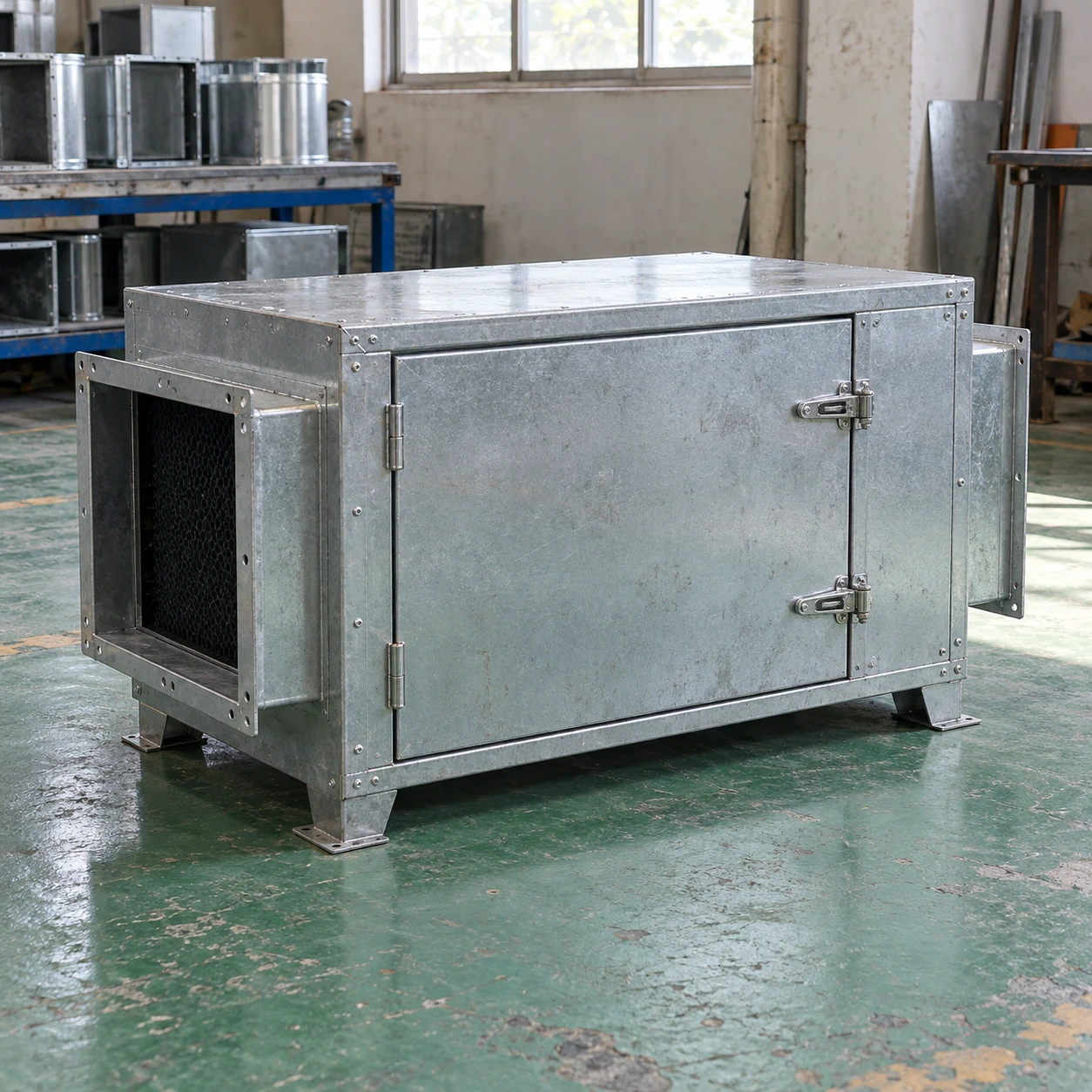
Air Filters
industrial activated carbon air filter
| Brand | shengtongJH |
|---|---|
| Assembly | Duct-mounted housing with replaceable carbon cassettes |
| Filter module W × H | 300 × 600 / 600 × 600 mm options |
| Cassette depth choices | 25 / 50 mm or a separately designed deeper bed |
| Duct connection options W × H | 400 × 400 / 600 × 600 / 800 × 600 mm |
| Housing envelope | Sized around module quantity, access travel and required transitions |
| Construction | Galvanized or stainless steel with compatible seals |
| Media selection | Untreated or application-specific impregnated adsorbent |
| Prefiltration | Separate dust or mist control where required before the carbon stage |
| Fan coordination | Clean and loaded system resistance included in fan selection |
| Access | Side-service door with room to withdraw each cassette |
| Monitoring provisions | Pressure taps and provision for suitable upstream/downstream sampling |
Module and connection dimensions are configuration options, not a fixed equipment rating. Media quantity, gas loading and pressure allowance must be selected together.
Housing layout, module count, materials, access side and duct interfaces can be customized to the industrial air-treatment duty.
An industrial activated carbon air filter is selected as part of a complete air-treatment route. The gas load, process operating pattern and upstream separation stages determine the carbon arrangement; a larger metal housing alone does not establish treatment capacity.
Define the process load before sizing the housing
New installations need more than a nominal ventilation volume. Establish what the process releases, whether the release is continuous or intermittent, and what operating conditions the treatment stage will see. A short production peak can be more demanding than an average concentration suggests.
Consider future changes explicitly. If the production line may add a second shift or use a different solvent, record those assumptions during selection. Leaving them unstated can produce a system that suits commissioning conditions but becomes unsuitable when normal production expands.
Separate the incoming challenges
Dust and liquid droplets can obstruct or foul an adsorbent. Choose appropriate upstream controls for the actual stream. A carbon stage should not be expected to act simultaneously as an effective grease separator, dust collector and universal gas-treatment device.
Coordinate contact and pressure
More media or a longer flow path may help the adsorption duty, but the associated resistance still has to fit the fan system. Compare the full air route, including transitions and other treatment stages. A fan rating in unrestricted air is not the installed operating point.
Allocate service space
A side-access box is useful only when the modules can be withdrawn. Show the service-door swing and removal path on the equipment layout. Keep those areas clear of permanent pipework and platforms so the carbon can be changed without a major shutdown.
Agree how performance will be evaluated
Set a relevant acceptance basis with the project team: the target compounds, representative operating conditions and the measurement approach. Avoid a vague requirement to remove all smells. Odour improvement and a specified pollutant concentration are different outcomes and should not be treated as interchangeable.
For complex, hot or potentially flammable process exhaust, ordinary ventilation hardware cannot be assumed suitable. The treatment train and operating safeguards need an application-specific engineering assessment. shengtongJH can source against the resulting defined specification without claiming a universal filter solution or an owned system-manufacturing facility.
Housing layout, module count, materials, access side and duct interfaces can be customized to the industrial air-treatment duty.