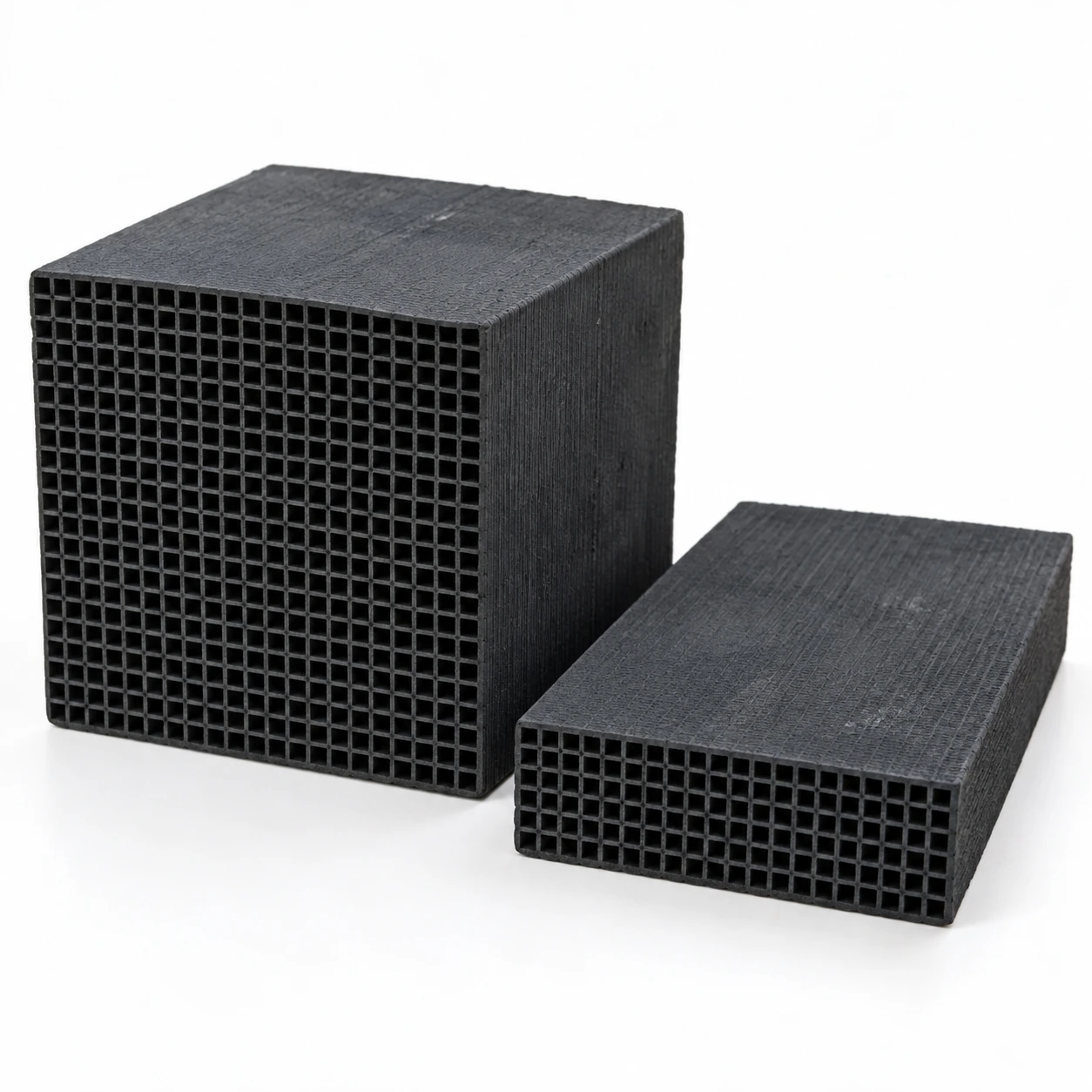
Air Filters
honeycomb activated carbon air filter
| Brand | shengtongJH |
|---|---|
| Sorbent form | Rigid formed activated-carbon honeycomb block |
| Block W × H × L options | 100 × 100 × 100 / 100 × 100 × 50 / 50 × 50 × 50 mm |
| Channel direction | Block length follows the open airflow channels |
| Channel selection | Cell size and wall construction selected for resistance and capacity |
| Module arrangement | Multiple blocks retained within a sealed supporting frame |
| Frame options | Galvanized or stainless steel module to the installation drawing |
| Edge sealing | Compatible perimeter closure to prevent bypass between blocks |
| Moisture suitability | Standard dry-service or documented moisture-resistant construction |
| Upstream protection | Particle or mist treatment selected for the incoming air |
| Replacement format | Individual blocks or complete framed modules as specified |
Block dimensions describe common forms, not complete-module performance. Channel density, sorbent composition, airflow and gas loading must be evaluated together; water resistance is not assumed.
Block dimensions, channel construction, module layout and supporting frame can be customized to the air-treatment equipment and service conditions.
A honeycomb activated carbon air filter can use rigid formed carbon blocks with many straight air passages. This page concerns the formed block construction, which differs from a plastic honeycomb carrier filled with loose granules or a carbon-coated foam sheet.
Use the channels as intended
The straight passages allow air to move through a structured adsorbent rather than through a randomly packed bed. Their size and the carbon wall construction influence both airflow resistance and the contact available for adsorption. A larger visible open area is not by itself proof of greater gas capacity.
Install the blocks with their channels aligned to the intended route. Gaps around the module or between poorly fitted blocks create bypass paths. The retaining frame and edge-sealing detail therefore matter alongside the carbon material.
Protect a rigid but fragile component
Formed blocks can be damaged by impacts or uneven clamping. Support them across appropriate contact surfaces and avoid forcing a chipped or oversized block into a tight frame. Damaged edges can leave an uncontrolled path for air even when most of the channel face remains intact.
Agree the handling and packing method for replacement blocks. Keep access sufficient to remove individual pieces without breaking adjacent material or dismantling unrelated ductwork.
Control what reaches the channels
Dust, grease and liquid droplets can obstruct the passages or interfere with the sorbent. Select upstream treatment for those contaminants rather than treating the honeycomb as a universal first-stage filter. A wet process exhaust requires a material and system assessment; the word honeycomb does not establish water resistance.
Choose by the gas challenge
Specify the target compounds, concentration range, operating hours and air conditions. A formed carbon block still has finite capacity, and a generic surface-area or iodine-value figure does not establish service life in every application. Different contaminants may require a different sorbent chemistry or a multi-stage arrangement.
Monitor gas-treatment performance with an appropriate method. Rising resistance can indicate blocked channels, while exhausted adsorption capacity may occur without a comparable pressure change. Do not use the absence of a strong smell as the sole acceptance test for an industrial air stream.
Order a complete usable module
State whether the supply is loose blocks or an assembled frame with seals and retainers. shengtongJH can coordinate that scope against the equipment drawing. This keeps a basic sorbent component distinct from a fully specified filter module and avoids unsupported claims about the performance of the complete installation.
Block dimensions, channel construction, module layout and supporting frame can be customized to the air-treatment equipment and service conditions.