Air Filters
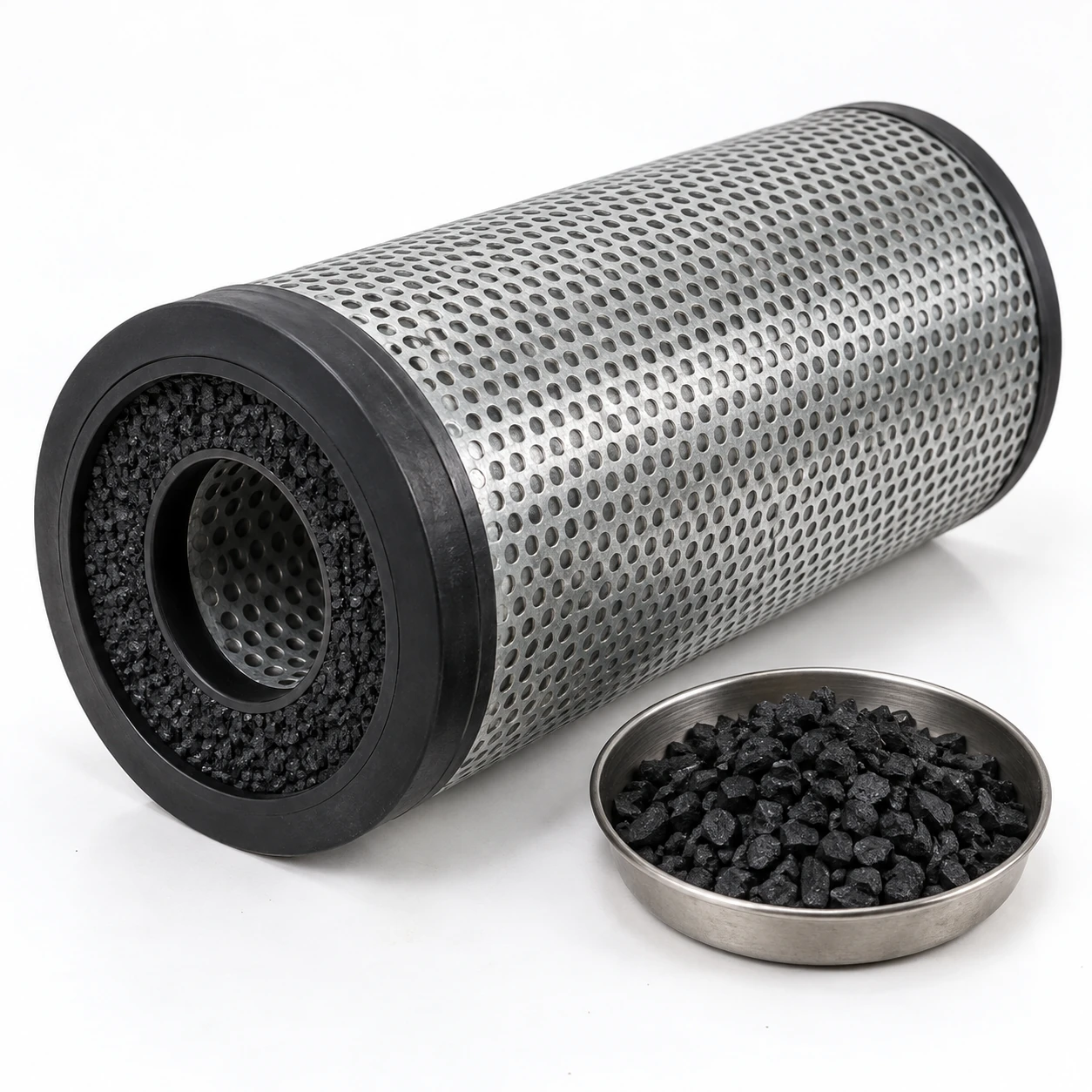
granular activated carbon air filter
| Brand | shengtongJH |
|---|---|
| Assembly form | Perforated cylindrical cartridge or separately specified granular bed |
| Cartridge diameter option | 145 mm nominal family; interface drawing determines fit |
| Cartridge length options | 450 / 600 mm |
| Mounting-bank option | Modules arranged on a compatible 610 × 610 mm base plate |
| Retaining shell | Galvanized or stainless steel with suitable fine retention layer |
| Sorbent form | Irregular granular activated carbon; not assumed equivalent to extruded pellets |
| Granule selection | Sieve range, hardness and fines content matched to the retaining structure |
| Media choice | Unimpregnated or contaminant-specific treated carbon as required |
| Air duty | Selected for gas identity, concentration, temperature, humidity and flow |
| Service options | Replaceable cartridge or a documented refill procedure for a refillable design |
Cartridge dimensions describe a common connection family, not universal compatibility. Flow, media mass and pressure loss must be selected for the actual cartridge bank and sorbent.
Cartridge length, retaining material, mounting interface and granular media specification can be customized to the air-treatment installation.
A granular activated carbon air filter holds loose, irregular carbon granules inside a retaining cartridge or bed. Air passes through the packed sorbent, allowing suitable gas molecules to adsorb onto its internal surfaces. The selected carbon grade and bed arrangement determine the useful duty.
Make the bed uniform, not merely full
Granular carbon needs to occupy the intended flow path without large voids or an open bypass around the container. Settling, uneven filling or a damaged retaining screen can create easier routes for air, reducing useful contact with the sorbent. The filling method and closure are therefore part of the filter construction.
Do not substitute a differently sized loose carbon simply because it fits inside the shell. Smaller particles can change resistance and escape through an unsuitable retainer; larger particles change packing and the contact arrangement. Compare the specified sieve range and physical properties with the cartridge design.
Match chemistry to the contaminant
Ordinary activated carbon does not treat every gas equally. Some duties require chemically treated carbon or a different sorbent. Identify the actual compounds and their concentrations before choosing the fill. An odour description alone may be insufficient where several gases are present.
Balance contact time with air delivery
Airflow, bed depth and sorbent quantity work together. Increasing the air volume through an unchanged bank can shorten contact time and alter removal performance. Specify the complete operating duty rather than transferring a removal claim from another cartridge arrangement.
Plan for capacity loss during service
A granular bed may reach the end of useful gas capacity while still allowing air to pass. Differential pressure is valuable for detecting obstruction, but it is not a direct measurement of remaining adsorption capacity. Use a suitable gas-monitoring, sampling or media-analysis plan for the application.
During replacement, handle spent media according to the substances it has captured and the site's procedures. Do not assume rinsing, drying or heating it on site restores the original capacity. A refillable shell still needs the correct fresh media and an approved filling method.
Define the purchasing boundary
State whether the order covers loose granules, complete cartridges or the mounting bank as well. shengtongJH can source against that defined scope, including interface details and required media documentation. This avoids receiving a compatible-looking component that lacks the seals or support hardware needed for installation.
Cartridge length, retaining material, mounting interface and granular media specification can be customized to the air-treatment installation.