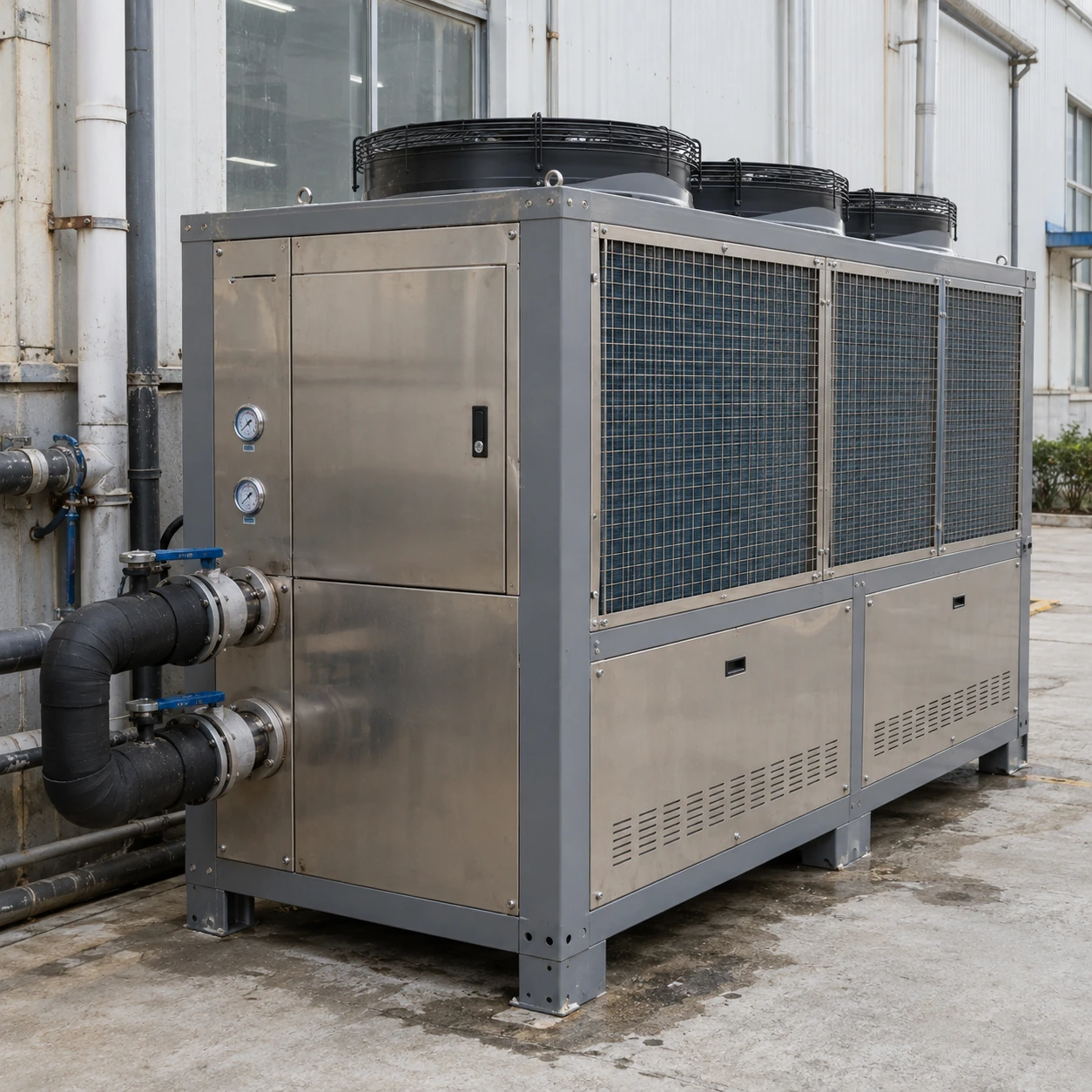
Air-Cooled Chillers
industrial air cooled chiller
| Brand | shengtongJH |
|---|---|
| Capacity configurations | Local packaged units through central multi-unit industrial plants |
| Cooling fluid | Treated water or compatible inhibited glycol; secondary heat exchanger for incompatible process fluids |
| Temperature duty | Positive-temperature cooling as selected; low-temperature duty requires a dedicated configuration |
| Construction | Coated steel frame; serviceable condenser coil; optional corrosion protection |
| Pump arrangement | Integral pump for local loads or separately selected process circulation |
| Envelope options, L × W × H (mm) | Local package around 1,300 × 800 × 1,400; larger package around 3,500 × 1,800 × 2,100; central layouts by duty |
| Electrical supply | Three-phase industrial supply; destination voltage/frequency specified at selection |
| Operating interfaces | Process permissive, remote alarm and flow/temperature monitoring options |
| Maintainability | Accessible strainer, isolatable water connections and service panel access |
Fluid compatibility, operating limits and electrical demand are confirmed for the selected equipment; a general industrial designation does not establish suitability for every process.
The fluid circuit, cooling duty, materials and operating interfaces can be customized for your industrial process.
An industrial air cooled chiller must fit the process fluid, heat-load pattern and operating environment. Cooling a production jacket, hydraulic heat exchanger or extrusion line can impose requirements that differ substantially from comfort air conditioning.
Protect the chiller from the process it serves
Production water can carry scale, fine solids, oils or chemicals that do not belong in a chiller evaporator. A strainer removes suitable particles but does not remove dissolved contamination or make an incompatible fluid safe. Where necessary, use a separate process loop and heat exchanger to isolate the refrigeration equipment.
Separation introduces an additional temperature approach and pressure loss. Account for both during selection: an apparently adequate chiller can fall short if the secondary heat exchanger needs colder water than the original duty assumed.
Mould and tooling cooling
Control water delivery to each tool and distinguish tool temperature requirements from general machine cooling. Deposits inside narrow channels can reduce heat transfer without an obvious change at the main chiller display.
Hydraulic and oil cooling
A water-to-oil exchanger keeps the fluids separate. The oil system's flow, viscosity and operating temperature influence the exchanger choice; an air-cooled water chiller does not directly replace that interface.
Batch and jacketed processes
Consider how rapidly stored heat must be removed after each batch. Peak cooling demand can be much higher than the shift-average load, especially during a short pull-down period.
Build around the operating environment
Dust and fibres can obstruct condenser fins. Corrosive air may call for suitable materials or coil treatment. A unit near a furnace or warm exhaust can see a much higher intake temperature than the general factory air. These conditions affect the useful cooling output and maintenance plan.
An ordinary industrial chiller should not be assumed suitable for a hazardous classified area. Locate equipment outside that area where appropriate, or specify the required certified arrangement through the project's engineering process.
Plan for continued production
Define what the process should do if cooling is unavailable: stop safely, reduce production or transfer to a standby circuit. Include temperature and flow permissives where the machine requires them. For critical loads, redundancy must address common pumps and power as well as compressors.
Useful purchasing information includes the process heat load, fluid condition, permitted temperature variation, maximum ambient and expected service access. These details allow a configuration to solve an operating problem instead of merely matching a nominal tonnage.
The fluid circuit, cooling duty, materials and operating interfaces can be customized for your industrial process.