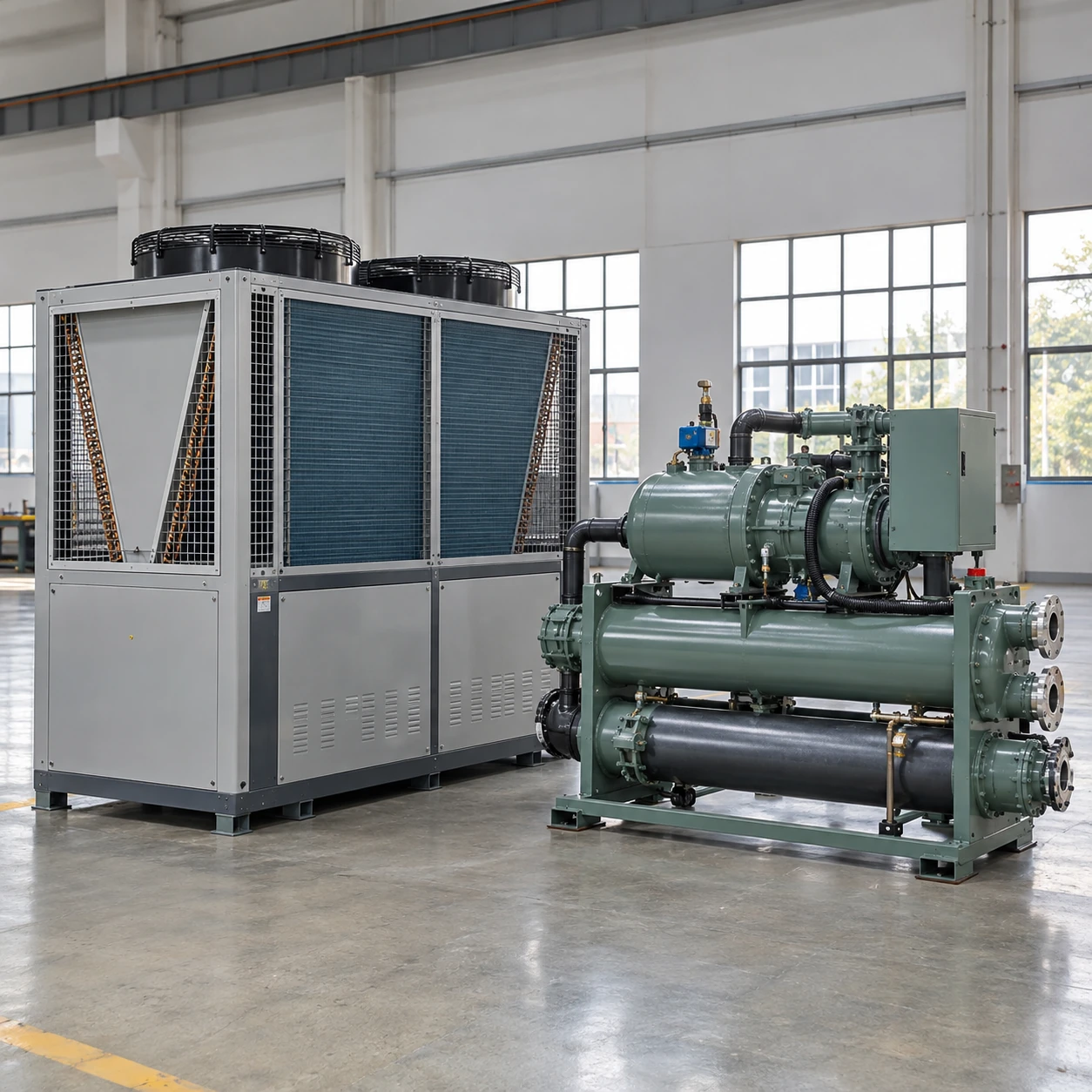
Air-Cooled Chillers
air cooled chiller vs water cooled chiller
| Supply brand | shengtongJH |
|---|---|
| Air-cooled heat rejection | Finned condenser and fans reject heat directly to air |
| Water-cooled heat rejection | Condenser-water circuit carries heat to a tower or another suitable heat-rejection system |
| Process circuit | Both types normally supply chilled water or a compatible cooling fluid |
| Capacity comparison | Use the same required cooling kW and leaving-fluid temperature |
| Site space | Air-cooled: coil airflow and service area; water-cooled: chiller space plus condenser-water equipment |
| Dimensions | Project-specific L × W × H in mm; include all plant items rather than comparing cabinets alone |
| Electrical comparison | Chiller plus fans/pumps/tower and auxiliary equipment, as applicable |
| Water-side equipment | Air-cooled: process loop; water-cooled: process loop and condenser-water loop |
| Selection deliverables | Matched duty selections, equipment layout, operating costs and maintenance scope |
Compare complete-system selections at the same required cooling duty, fluid temperature and local design conditions.
The cooling arrangement, plant layout and supporting equipment can be selected for your industrial duty, water availability and maintenance resources.
The choice between an air cooled chiller and a water cooled chiller is a choice of heat-rejection system as well as a refrigeration machine. Compare the complete installation at the same cooling duty and operating conditions, including the equipment outside the chiller cabinet.
Where air cooling simplifies the project
An air-cooled package avoids a separate condenser-water tower circuit in a conventional installation. That can reduce the number of water-side systems to operate and is useful where water availability, treatment facilities or plant-room space are limited.
It still needs a process-water circuit and adequate airflow. On a hot day, or in a yard that recirculates its own warm discharge, refrigeration performance can deteriorate. Outdoor location, coil condition and noise therefore become major selection issues.
Where water cooling can justify more infrastructure
A suitable water-cooled arrangement can operate with a lower condensing temperature than an air-cooled unit under many conditions. For a large, heavily used plant, that can make its energy performance attractive.
The comparison must include condenser pumps, heat rejection, treatment and maintenance. A cooling tower also introduces water consumption and operating responsibilities. A site with an existing well-managed condenser-water system is a different proposition from a site building everything from scratch.
Compare the bill for the whole plant
Do not compare only compressor input at one rating point. Build an annual operating profile from the process load and local weather, then account for all associated electrical equipment. Include water, treatment, cleaning, inspection and the labour needed to keep each system available.
A low purchase price can be offset by difficult access or an unsuitable operating envelope. Conversely, a more complex plant may be hard to justify when it runs only occasionally or when the site has limited maintenance support.
Air cooled does not mean water-free
The term describes the condenser's heat-rejection method. The factory process may still circulate substantial water through its evaporator. Likewise, a water-cooled chiller need not circulate raw tower water through the production machines: the chilled-water and condenser-water circuits have different functions.
Make the decision from site constraints
List available electrical supply, water services, outdoor space, permitted noise, operating hours and required resilience. Request comparable selections using the actual fluid and temperatures. shengtongJH can coordinate the chiller and supporting equipment around those conditions; the preferred type depends on the installation rather than a universal efficiency claim.
The cooling arrangement, plant layout and supporting equipment can be selected for your industrial duty, water availability and maintenance resources.