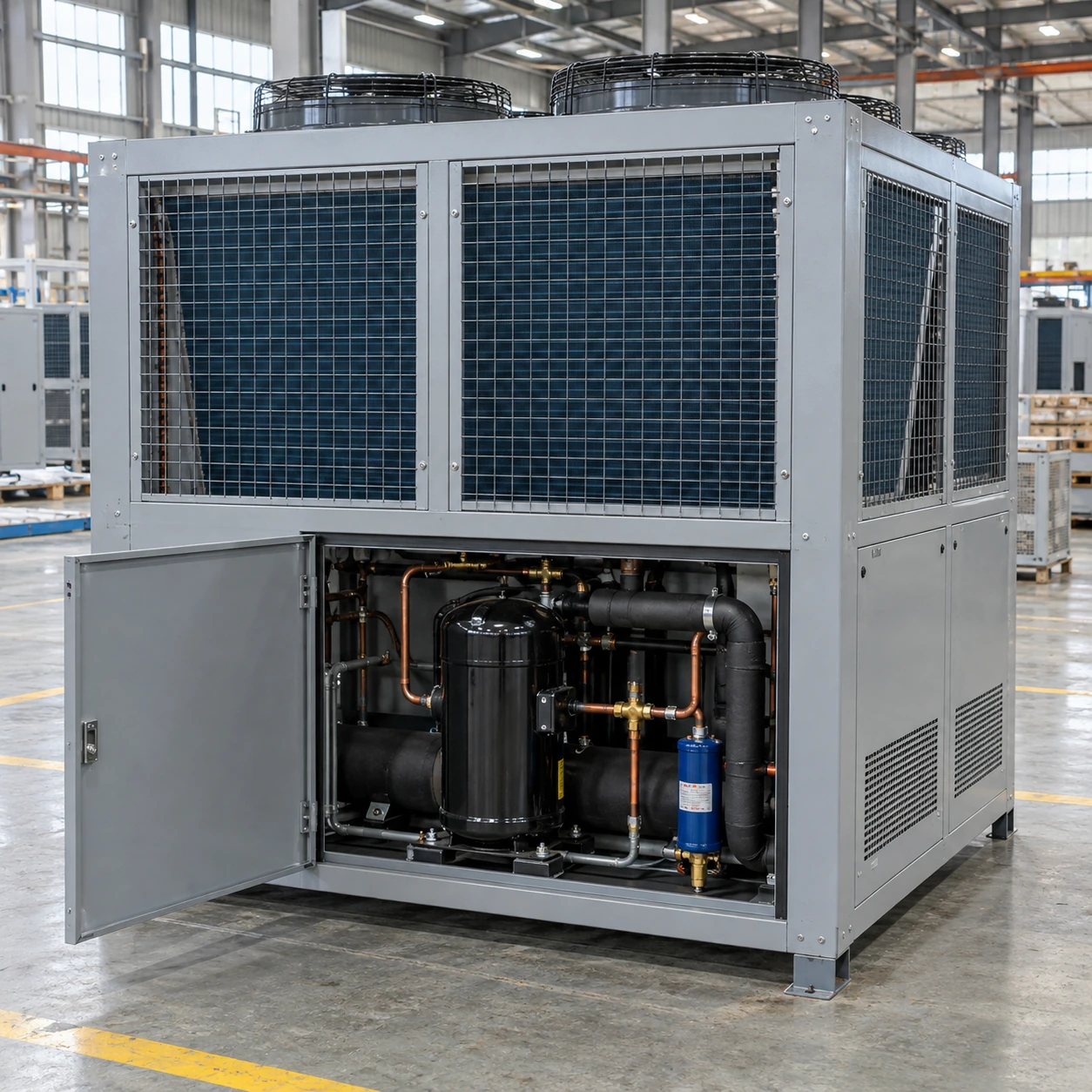
Air-Cooled Chillers
air cooled chiller manufacturer
| Supply brand | shengtongJH |
|---|---|
| Build types | Compact packaged, outdoor scroll, screw and multi-unit configurations |
| Duty inputs | Thermal load, required coolant temperature, fluid composition and ambient conditions |
| Cabinet material | Coated steel; corrosion and enclosure options selected for the installation |
| Heat-exchanger selection | Evaporator materials and condenser construction matched to fluid and environment |
| Dimensional deliverable | L × W × H in mm, connection positions, panel opening and component removal space |
| Electrical configuration | Destination voltage/frequency and agreed starting/control arrangement |
| Control deliverable | Operating sequence, setpoint range, protections and external interface list |
| Build review | Agreed component schedule and review of proposed substitutions |
| Handover | Equipment identification, operating documents, wiring and agreed inspection records |
Manufacturing, testing and documentation requirements form part of the agreed supply specification and are matched to the selected equipment.
Equipment construction, interfaces, inspection requirements and documentation can be tailored to your process and procurement specification.
Selecting an air cooled chiller manufacturer involves turning a cooling requirement into a buildable, maintainable equipment specification. shengtongJH coordinates technical specifications, documentation and supply requirements with industrial equipment sources.
Specify interfaces before fabrication
Connection positions, service-panel direction and lifting access can determine whether a chiller fits the intended installation. Record those constraints on the arrangement drawing before manufacture. A cabinet that fits the pad may still be impossible to maintain if a compressor or strainer cannot be removed.
The water circuit also needs defined pressure, fluid and material requirements. These influence the evaporator, pump, seals and connections; they cannot reliably be decided from an exterior photograph.
Make component choices serve the process
A compressor should suit the required operating envelope and capacity control. The evaporator must suit the fluid and cleaning strategy. The condenser must reject heat under the actual site conditions. Selecting each component by reputation alone does not demonstrate that the assembled machine meets the duty.
Keep an agreed component schedule where specific parts are important. A proposed substitution should be reviewed for performance, electrical characteristics, controls and service implications before it is accepted.
Design review
Confirm selected duty, dimensions, interfaces and operating limits. Resolve open technical points before the build is released.
Assembly review
Check the agreed construction and accessible service arrangement. Match the equipment identity with the purchase specification.
Handover review
Verify required documents and agreed functional evidence. Define any remaining site commissioning work explicitly.
Separate factory checks from installed performance
A factory function check can establish that controls and components operate under its test conditions. The installed system also depends on site flow, water quality, electrical supply and condenser airflow. Agree the relevant evidence for both stages instead of using one general inspection label.
Keep the equipment maintainable after delivery
Request usable wiring information, operating limits, alarm descriptions and service-component identification. Confirm what local service is needed and who supplies it. The result should be an equipment package that maintenance staff can understand, rather than a machine supported only by a sales specification.
Equipment construction, interfaces, inspection requirements and documentation can be tailored to your process and procurement specification.