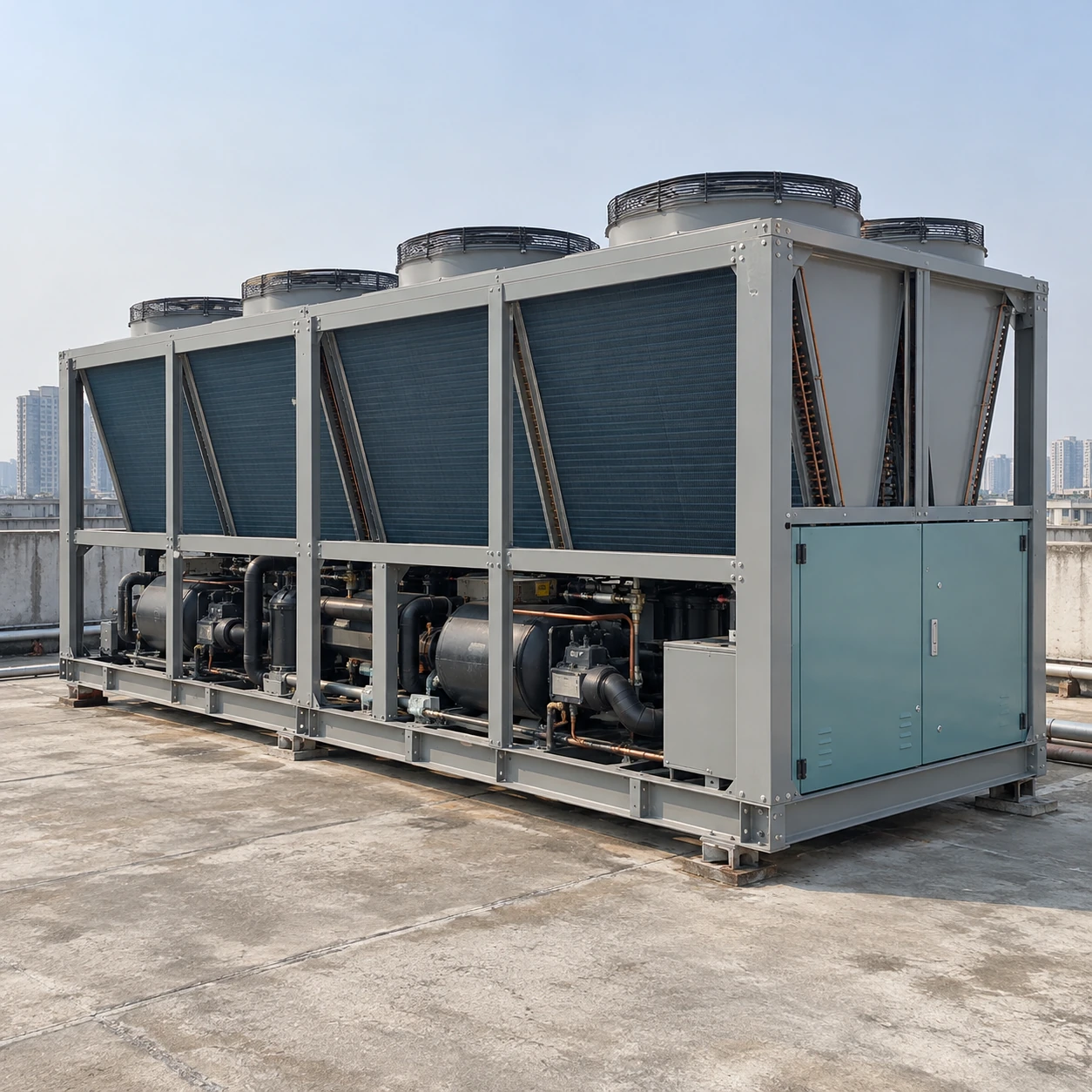
Air-Cooled Chillers
80 ton air cooled chiller
| Brand | shengtongJH |
|---|---|
| Nominal cooling duty | 80 US RT = 281.35 kW thermal |
| Refrigeration options | Staged scroll or screw compressor package |
| Calculated water flow, 5 K rise | 48.39 m³/h |
| Outdoor enclosure | Coated steel with application-specific coil protection options |
| Envelope options, L × W × H (mm) | Approximately 4,000–5,800 × 2,000–2,400 × 2,100–2,600 |
| Water-side options | External pump station; insulated pipes; compatible freeze protection where needed |
| Electrical supply | Industrial three-phase configuration; operating and starting data provided with selection |
| Control options | Remote operation, alarm indication and low-ambient control package |
| Mounting | Engineered support points and vibration isolation selected for the structure |
Envelope dimensions exclude airflow and maintenance space. Structural loads, noise and duty performance must be checked for the selected unit and site.
Mounting, coil protection, winter operation and hydraulic interfaces can be customized to the installation environment.
An 80 ton air cooled chiller is often placed outside to move heat and noise away from production. The roof or utility-yard layout must preserve condenser airflow and service access throughout the life of the installation.
A roof is not automatically an open-air installation
Parapets, acoustic screens and nearby plant can obstruct intake air or return warm discharge to the coils. The actual condenser inlet temperature may then exceed the weather design temperature. Review airflow paths across the whole roof instead of using only the cabinet footprint.
Clearance requirements are specific to the selected unit, fan arrangement and surrounding obstructions. A generic one-metre gap is not an adequate design rule for every chiller.
Support and vibration
Use operating mass, fluid content and support reactions when designing the structure. Isolation must suit the equipment and supporting structure, with pipework arranged so it does not bypass the isolation.
Service access
Provide a safe route to panels, coil faces and water-side components. Initial crane access should be considered alongside future component replacement.
Noise
Assess the selected operating mode at the relevant receiver. Barriers or quieter fan options can affect airflow or available capacity and should be evaluated together.
Protect the water circuit through a shutdown
An outdoor evaporator or exposed pipe can freeze when refrigeration is off. Select an appropriate combination of compatible antifreeze, heating, circulation or drainage according to the installation and equipment instructions. A powered heater is ineffective during a power outage unless the protection strategy accounts for it.
Glycol changes heat transfer and pressure drop, so the pump and chiller selection must use the actual mixture. Insulation also needs a durable vapour barrier and weather protection.
Give the supplier the site, not just the tonnage
Provide the planned location, surrounding wall heights, maximum intake air temperature, noise constraints and water temperatures. These details determine whether the standard configuration is suitable or whether the condenser, controls or layout must change.
Mounting, coil protection, winter operation and hydraulic interfaces can be customized to the installation environment.