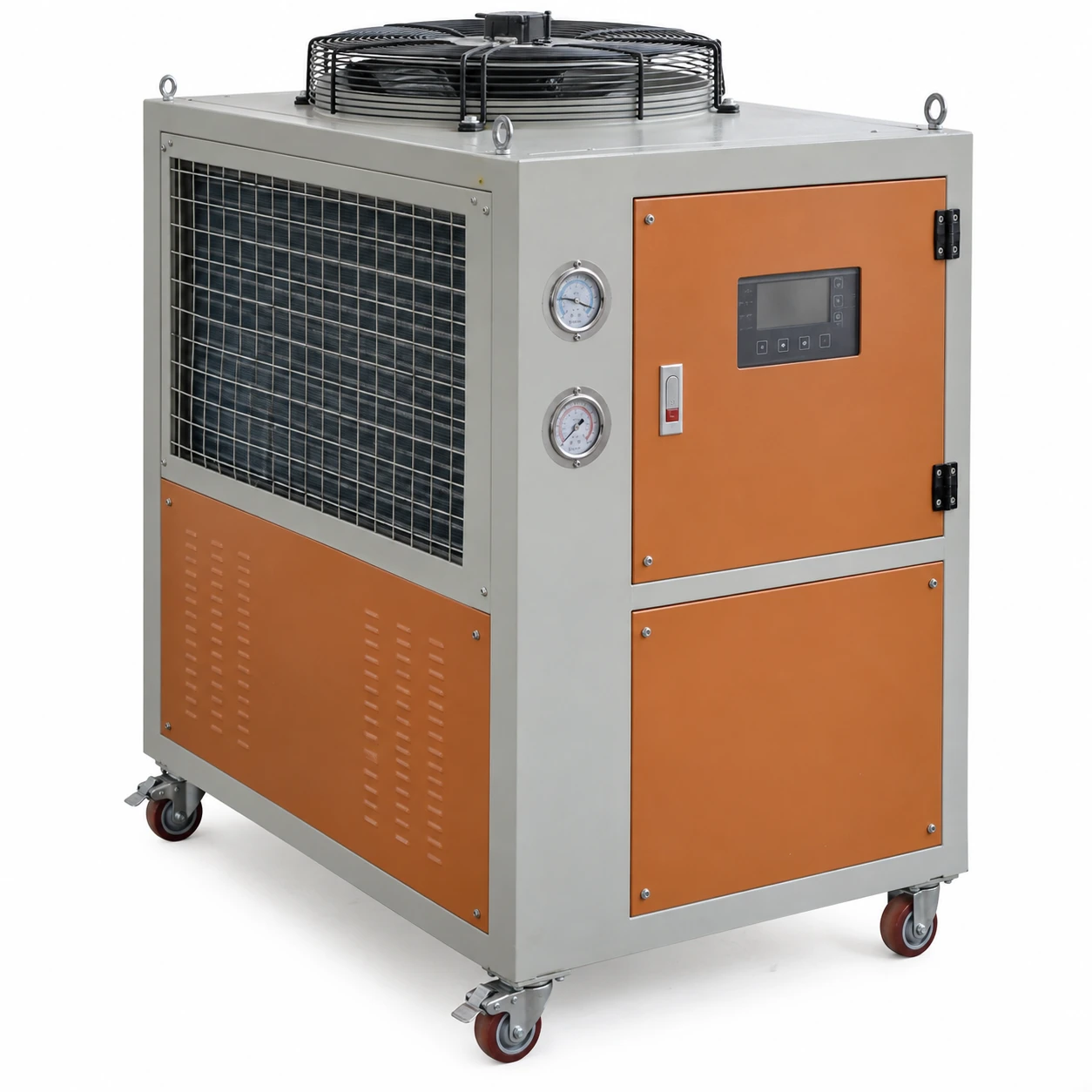
Air-Cooled Chillers
5 ton air cooled chiller
| Brand | shengtongJH |
|---|---|
| Nominal duty | 5 US RT = 17.58 kW thermal |
| Compressor / condenser | Compact scroll package with fan-cooled finned condenser |
| Calculated water flow, 5 K rise | 3.02 m³/h |
| Tank / pump | Integrated reservoir and pump options; pump head matched to the tool circuit |
| Water temperature | Common positive-temperature process selection; colder duty requires compatible fluid and equipment |
| Envelope options, L × W × H (mm) | Approximately 1,100–1,500 × 650–850 × 1,100–1,500 |
| Electrical supply | Three-phase industrial package; voltage and frequency selected for destination |
| Handling | Fixed feet or load-rated castors according to installation |
| Protection | Low-flow and temperature protection, compressor overload and refrigeration alarms |
Nominal duty and calculated flow are selection values. Confirm actual output, input power, tank size and final dimensions for the chosen package.
Pump duty, reservoir, connections and enclosure can be customized for your local industrial cooling application.
A 5 ton air cooled chiller provides local process cooling without a central chilled-water connection. It can be practical for a work cell or small production tool when the surrounding space can accept its heat rejection.
Make local cooling practical
A dedicated unit avoids extending a central loop to a distant machine and lets the local process use its own temperature setting. It also places a compressor, fan and warm exhaust near the workplace. Consider those effects before choosing the convenient empty space beside the tool.
In an enclosed room, the unit adds the removed process heat and its compressor energy to the room air. Ventilation or a different heat-rejection location may be necessary. Do not attach improvised ductwork to a fan that has not been selected for the additional resistance.
Match pressure as well as capacity
A small mould or heat exchanger may have narrow passages and significant resistance. Select the pump from the required flow at the actual system head. Excessive pressure can damage hoses or seals, while inadequate flow can let the process overheat even with cold water in the tank.
Use the correct water
Follow the equipment's water-quality limits. Very low-conductivity water is not automatically compatible with every pump and wetted material. Where glycol is necessary, select its chemistry and concentration deliberately and account for the change in heat transfer and pumping resistance.
Portable does not mean connect anywhere
Moving a unit between work cells changes its electrical, ventilation and piping conditions. Check the supply and phase arrangement, hose compatibility, condenser clearance and drain route at each location. Lock castors where provided and avoid imposing pipe loads on the cabinet connections.
Watch the useful indicators
Record normal supply and return temperatures, fluid level and process flow after commissioning. If performance later drops, those values help distinguish low fluid, blocked circulation and condenser fouling from insufficient refrigeration. Maintain accessible filters and coils rather than waiting for a high-temperature alarm to interrupt production.
Pump duty, reservoir, connections and enclosure can be customized for your local industrial cooling application.