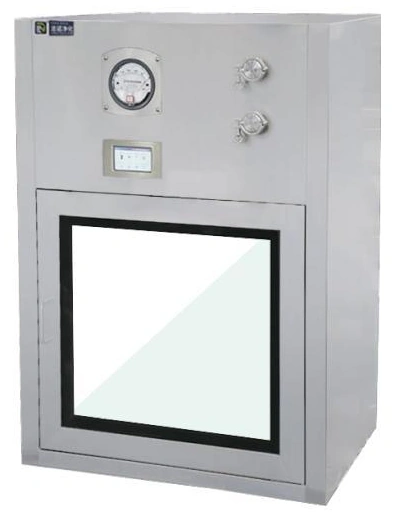
Pass Boxes & Material Transfer
Xenon Light Pass Box
| Specification | JN-XLPB |
|---|---|
| Chamber and external dimensions | Configured around the transfer load, treatment space and installation opening |
| Treatment source | Pulsed xenon lamps |
| Treatment timer | 0–99 minutes, adjustable |
| Airflow velocity setting | 0.45 m/s ±20% |
| Enclosure and doors | Brushed 304 stainless steel |
| Door construction | Inset doors with electronic interlock |
| Observation glazing | Double glazing with 5 mm tempered panes |
| Electrical supply | 220 V / 50 Hz |
| Controls | Electronic controller, magnetic interlock, cycle timing and abnormal-operation alarm |
| Size customization | Available for the items, loading pattern and room interface |
Dimensions and configurations can be customized for your application.
Combine interlocked material transfer with pulsed-xenon surface treatment and filtered chamber airflow. The arrangement is developed around the items being passed, the surfaces requiring treatment and the available wall opening.
Define the surfaces that need treatment
A xenon-light pass box addresses a different problem from a simple transfer hatch. The doors control access between rooms, while pulsed light is used to reduce microbial contamination on exposed surfaces. This makes the arrangement relevant when the outer surfaces of transferred items need a controlled treatment step before they reach the receiving area.
The treatment does not automatically reach inside a closed container, beneath overlapping packs or into a shadowed recess. Begin with the actual item and its packaging: which surfaces must be exposed, which surfaces are hidden, and whether changing the loading orientation would make coverage more consistent. A larger chamber alone does not resolve an inaccessible surface.
Light exposure and air cleanliness do different jobs
Pulsed-xenon lamps deliver brief, intense light pulses for surface treatment. The filtered-air arrangement manages airborne particles within the chamber. Interlocked doors control when the two room sides can be accessed. These functions work together, but one cannot be used as proof that the others have achieved their purpose.
For a process that requires a defined microbial reduction, establish acceptance using the intended load pattern, relevant challenge and selected cycle. A timer value or a clean-air reading on its own cannot establish surface-treatment effectiveness.
A repeatable loading pattern
- Keep items separated so one item does not shade another.
- Use a support arrangement that exposes the required surfaces without unstable stacking.
- Remove visible soil before treatment using the product's compatible cleaning method.
- Check packaging, labels and sensitive components for compatibility with repeated exposure.
Make release depend on a completed cycle
After loading, the entry door closes and the electronic interlock holds the opposite door. The controller manages treatment and the subsequent release sequence. This gives operators a clear boundary between an item awaiting treatment and one ready for transfer.
Define what happens after a power interruption, an interrupted cycle or a door fault. The receiving operator needs a reliable indication of completion rather than simply seeing an illuminated chamber. Any recovery procedure should distinguish a load that completed treatment from one that needs to be processed again.
The enclosure and viewing arrangement must be suitable for the selected light source. Lamp emission must stop when access is unsafe; observation glazing alone is not a substitute for a functioning door-safety circuit.
Build maintenance into the wall interface
Lamp condition, clean optical surfaces and unobstructed airflow affect repeatability. Leave access for lamp replacement, filter service and checks of the seals and door sensors. A crowded service side can turn a routine replacement into a room disruption.
Provide the item dimensions, packaging materials, batch arrangement and required treatment outcome when discussing this product. Chamber geometry, lamp placement, airflow and cycle controls can be customized to suit the transfer scenario. Discuss your material-transfer requirements.