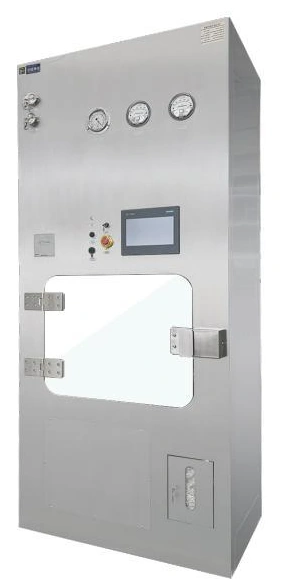
Pass Boxes & Material Transfer
Hydrogen Peroxide Pass Box
| Specification | Configuration |
|---|---|
| Enclosure material | 304 stainless steel |
| Work chamber material | 316 stainless steel |
| Chamber and external dimensions | Custom W × D × H in mm, matched to load and installation space |
| Airflow arrangement | Vertical unidirectional airflow |
| Treatment system | Vaporized hydrogen peroxide with concentration monitoring |
| Door control | Electronic interlock with door status monitoring |
| Operator interface | Touchscreen with cycle progress and fault indication |
| Compressed air supply | 0.6–0.8 MPa |
| Power supply | 220 V, 50 Hz |
| Customization | Chamber size, transfer opening and installation interfaces |
Dimensions and configurations can be customized for your application.
Transfer materials across a controlled boundary with an enclosed hydrogen peroxide treatment cycle. Interlocked doors, monitored operation and post-cycle aeration connect the treatment stage with a practical loading and unloading routine.
A transfer boundary with a treatment stage
Packaging, tools and other incoming items can carry surface contamination into a controlled production area. Passing them through an ordinary interlocked box separates door openings, but does not itself provide a hydrogen peroxide treatment. This pass box adds an enclosed process between loading and release, reducing the need to move untreated outer surfaces directly across the boundary.
The useful capacity is the space that can be loaded while still exposing the required surfaces. A chamber packed tightly to its walls may physically hold more items but leave contact areas or obstructed surfaces outside effective treatment. Select the arrangement around the actual trays, containers and packaging, together with the transfer frequency.
Follow the load through the chamber
Load with access to surfaces
Present cleaned, compatible items in the defined loading arrangement. Shelves and supports should keep the load stable without creating unnecessary covered areas. Closed containers, nested components and wrapped goods need separate consideration; treating an outside surface does not establish treatment of inaccessible contents.
Run a controlled cycle
Door status and cycle control keep the transfer sequence together. The treatment recipe must suit the load, its materials and the intended microbiological outcome. Concentration monitoring and clear cycle-status indications help distinguish a completed process from an interrupted run.
Aerate before release
Hydrogen peroxide must be removed to the defined release condition before the receiving door is opened. Exposure and aeration both affect throughput. Counting only the treatment period can underestimate the time needed to deliver the next load.
Material compatibility is part of the selection
Review plastics, elastomers, adhesives, coatings and sensitive electronics in the load as well as the stainless chamber. A material that tolerates a single exposure may behave differently after repeated cycles. Absorbent packaging can also affect residual peroxide and aeration time. Product or packaging instructions and load-specific assessment should determine what enters the chamber.
Performance qualification should address the intended load and difficult-to-reach locations. A displayed cycle completion message alone does not establish sterility of every possible item. Where sterile transfer is required, define the acceptance criteria, monitoring approach and release responsibility as part of the process.
Make the wall connection serviceable
Coordinate the wall opening, sealing faces, loading height and door swing with the two adjoining rooms. Place services and maintenance access where a technician can reach them without turning the receiving room into a service corridor. The chamber installation must work with the room pressure arrangement and the selected aeration connection.
Useful information for a quotation
Send the largest load outline, its materials, expected transfers per shift and a plan of the wall position. Include available utilities, receiving-side requirements and any cycle-record requirements. These details establish the chamber configuration more accurately than a nominal box size alone.
Chamber dimensions, load supports and transfer interfaces can be customized for your application and installation conditions. Discuss your material transfer requirements.