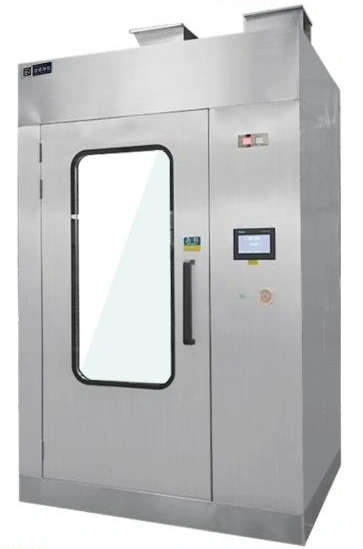
Mist Showers
Mist Shower
| Specification | Configuration |
|---|---|
| Enclosure material | Brushed 304 stainless steel |
| External dimensions | Custom W × D × H in mm to suit occupancy and installation |
| Viewing panel | 5 mm tempered glass |
| Misting system | Fine-water atomization |
| Water inlet pressure | 1–2 bar |
| Water temperature | Ambient-temperature purified water |
| Door operation | Interlocked entry and exit |
| Controls | PLC interface, presence detection and adjustable operating cycle |
| Lighting | Recessed LED |
| Power supply | 220 V AC, 50 Hz |
Dimensions and configurations can be customized for your application.
A controlled misting chamber that wets exposed garment surfaces to help hold loose particles in place. The enclosure, entry sequence and cleaning arrangement should work together with the site's changing and contamination-control procedure.
Keep loose powder from following the operator
Particles on protective clothing can become airborne when an operator walks, bends or removes a gown. Fine mist wets exposed garment surfaces so loose powder is less easily released during the next handling step. This is particularly relevant when a personnel exit leads from powder processing into a changing area.
The useful result is controlled wetting, not simply a chamber filled with visible fog. Coverage must suit the garment and operator position without producing unnecessary saturation or runoff. The powder, clothing and water response all influence the appropriate cycle.
Build the exit route around the next action
Before misting
The operator arrives wearing the required protection. The entry door, standing position and cycle indication should make the sequence clear, particularly where different shifts or visiting maintenance staff use the same route.
During the cycle
Interlocked doors help keep the route controlled while mist is applied. Position and movement instructions should match the coverage assessment. A timer alone cannot show that every garment surface received the intended treatment.
After misting
The operator needs a defined route to remove or manage the affected clothing. Provide the appropriate garment collection and cleaning arrangements so damp contaminated surfaces are not carried into a general corridor.
Water, clothing and cleaning must be compatible
Assess whether the material on the garment can be wetted safely and whether moisture affects the garment's protection. Plain water mist does not establish microbial inactivation or chemical neutralization. Adding a chemical requires a separate assessment of exposure, compatibility and process effectiveness; an occupied chamber must not be treated like an unoccupied room-fogging process.
Define water quality, supply connections and how the wet surfaces are cleaned and dried. Where liquid is collected or drained, include its containment and disposal route in the design. Repeated wetting without a suitable cleaning routine can leave residues on floors, seals and chamber surfaces.
Maintenance access matters here as much as access through the doorway. Atomization components, water connections and filtration need to remain reachable after the chamber is fitted between partitions. A small service clearance can become a major interruption if routine work requires dismantling an adjoining room.
Mist shower or air shower?
A conventional air shower uses filtered air jets to dislodge loose particles. A mist shower uses wetting as part of a controlled garment-handling process. The choice depends on the contamination and required handling method; the two devices are not interchangeable simply because both have interlocked doors.
Configure for the people and the process
Share the garment type, substance being controlled, direction of travel, peak user numbers and the planned changing sequence. Add the available floor space, water services and cleaning method. Chamber dimensions, door arrangement and cycle controls can be customized for the application and site conditions. Discuss your mist shower layout.