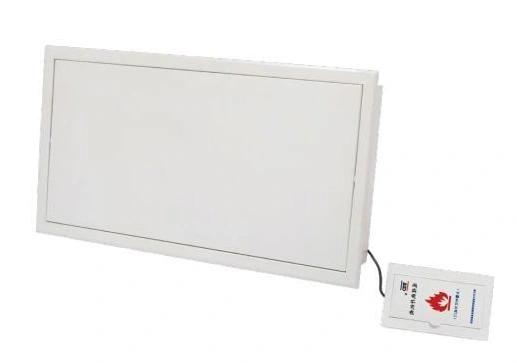
Remotely operated plate-type smoke exhaust outlet
Fire & Smoke Control Dampers
Plate-Type Smoke Exhaust Outlet
| Specification | Remote-control arrangement | Local-control arrangement |
|---|---|---|
| Face arrangement | Plate-type outlet panel | |
| Operation | Remote operating point | Local operating point |
| Installation interface | Smoke-extract opening / shaft connection | |
| Dimensions | Selected to the opening and supported assembly | |
| Controls | Coordinated with the project smoke sequence | |
Dimensions and configurations can be customized for your application.
A plate-type smoke exhaust outlet provides a panelled face for an extraction opening. Local and remote operating arrangements allow the outlet mechanism to be coordinated with the building layout and smoke-control strategy.
A coordinated face for the extraction opening
The plate-type arrangement provides a defined panel face where the smoke-extract route meets the occupied area. Behind that face, the mechanism must create the intended opening when commanded. The visible panel, operating parts and connection to the extraction route should therefore be selected together.
The surrounding finish should not obstruct movement. Coordinate the frame depth, edge clearances and any panel projection before nearby cladding or decorative work is installed. An opening that looks neat when closed still needs its full operating space.
Local operation
A local operating point suits an arrangement where the mechanism can be reached at the outlet. Its location must remain accessible during normal use, inspection and reset. Do not position fixed equipment or finishes in front of the controls simply because they are rarely used.
The local control function should be defined alongside the automatic system. Identify which actions are permitted locally and how the outlet returns to its normal state.
Remote operation
A remote operating point separates the control location from the outlet face. This can help where the panel is high or difficult to reach. The connection between control and mechanism needs a suitable route, support and access for inspection.
Remote control does not mean maintenance-free operation. The panel and mechanism still need a reachable service route, and the installed connection must be checked through its full operating movement.
Match the opening to the smoke route
The required extraction duty depends on the route behind the outlet as well as its face dimensions. Frame and mechanism obstructions affect the open passage. Coordinate the outlet with the shaft or duct connection and available pressure rather than sizing it solely from the wall opening.
The normal state, alarm response and any protective closure function must follow the selected smoke-control design. The outlet needs to reach the intended state in coordination with the extract fan and other smoke-control components. Use the documentation for the actual assembly to establish its permitted application and installation.
Check operation after the finishes are complete
Panel movement
Confirm that paint, trim and fixings do not catch the panel or bridge moving joints.
Control response
Operate the local or remote mechanism through the intended sequence and verify any required feedback.
Clear approach
Keep the face and access points clear of storage and later fit-out changes.
Dimensions, face finish and operating arrangement can be customized within the supported assembly and project requirements. Discuss the outlet location and control method.