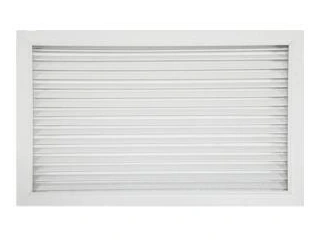
Single-deflection grille
Fan Filter Units & Air Terminals
Aluminium Air Grilles & Louvres
| Specification | Directional grilles | Fixed and hinged grilles | Weather louvres | Gravity louvre |
|---|---|---|---|---|
| Configurations | Single-deflection / double-deflection | Fixed / hinged fixed / hinged adjustable | Weather / rain-resistant arrangement | Free-moving blade arrangement |
| Main material | Aluminium alloy | |||
| Typical role | Supply-air direction | Return face and service access | Exterior air opening | Directional airflow opening |
| Dimensions | Matched to duct or wall opening | Matched to opening and access needs | Selected to opening and required free area | Selected to opening and operating direction |
Dimensions and configurations can be customized for your application.
Grilles and louvres finish the air opening while shaping its practical function. Adjustable blades direct supply air, fixed and hinged faces serve return openings, and weather or gravity arrangements address exterior and directional-flow needs.
Choose the face by what the opening must do
A grille is more than a cover for a duct. Its blades influence direction, resistance, visibility and access. Choosing only by the wall opening can result in a supply jet aimed at occupants, a return face that is difficult to clean or an exterior opening with unsuitable rain protection.
Begin with the role of the opening. Supply, return, transfer and exterior intake duties have different priorities. The eight arrangements shown provide a choice of blade and frame functions without assuming that one grille type serves them all equally well.
Direct air where it is useful
Single deflection
One adjustable blade direction gives control over the principal discharge angle. Coordinate the selected direction with nearby walls, workstations and the intended room air path.
Double deflection
Two blade directions provide more adjustment of the discharge pattern. Extreme blade settings also change resistance and can create noise, so use the adjustment as part of a balanced outlet arrangement.
Fixed blades
A fixed face provides a consistent appearance and passage geometry where adjustable direction is unnecessary. It can suit return openings when selected for the required airflow and pressure loss.
Use hinged frames where access matters
A hinged fixed or adjustable face makes the space behind the grille easier to reach. This can help where a filter, damper or inspection point needs regular attention. Check the opening direction, latch access and clear space in front of the face so the hinge remains useful after fit-out.
The grille should not be expected to support unrelated equipment behind it. Coordinate any filter holder or damper separately and keep the removal route clear. Accessible components are more likely to be cleaned and maintained without damage to the surrounding finish.
Exterior openings need an airflow and weather balance
Weather and rain-resistant blade arrangements reduce direct rain entry, but their suitability depends on exposure and operating airflow. The free area is smaller than the overall face area and varies with size and construction. Select the opening with its resistance and water-management arrangement in mind.
A weather louvre should not be described as waterproof without the applicable performance evidence. Provide drainage and a suitable arrangement behind the face where the installation requires it.
Gravity blades need freedom to move
A gravity louvre responds to airflow and its installed orientation. Keep the blades clear of obstructions and confirm the permitted mounting direction. Its function differs from a fixed weather blade or a manually adjusted supply grille.
Coordinate the visible and hidden dimensions
Distinguish the wall opening, duct connection and outer frame before ordering. Blade arrangement, finish, hinge direction and dimensions can be customized to the application. Discuss the opening and airflow requirement.