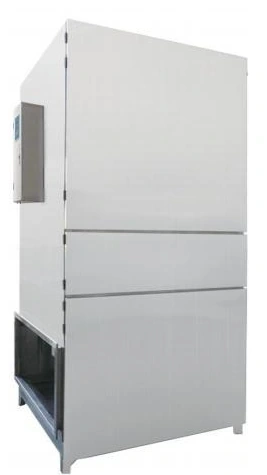
Dust Collectors
Cartridge Dust Collector
| Motor power | Airflow (m³/h) | Pressure (Pa) | External dimensions (mm) | Inlet Ø (mm) | Outlet (mm) |
|---|---|---|---|---|---|
| 0.75 kW | 1200 | 1210 | 600 × 600 × 1500 | 200 | 250 × 200 |
| 1.1 kW | 1600–1800 | 520–860 | 650 × 650 × 1600 | 200 | 250 × 200 |
| 1.5 kW | 1131–2356 | 606–994 | 750 × 750 × 1650 | 200 | 320 × 200 |
| 2.2 kW | 1688–3517 | 792–1300 | 800 × 800 × 1700 | 250 | 320 × 250 |
| 3 kW | 2664–5268 | 989–1578 | 850 × 850 × 1750 | 300 | 400 × 320 |
| 4 kW | 2750–5350 | 1100–1620 | 850 × 850 × 1800 | 300 | 400 × 320 |
| 5.5 kW | 4012–7419 | 1320–2014 | 950 × 950 × 2000 | 350 | 500 × 400 |
| 7.5 kW | 5712–10562 | 1673–2554 | 1050 × 1050 × 2050 | 350 | 500 × 400 |
| 11 kW | 7528–13800 | 1988–3000 | 1250 × 1250 × 2450 | 500 | 630 × 400 |
| 15 kW | 7728–15455 | 2019–3187 | 1250 × 1250 × 2550 | 500 | 630 × 400 |
| Filtration medium | Pleated filter cartridges | ||||
| Cleaning arrangement | Pulse cleaning with compressed-air manifold and solenoid valves | ||||
| Dust discharge | Lower collection drawer | ||||
| Customization | Cartridge and connection arrangement for the process | ||||
Dimensions and configurations can be customized for your application.
Use pleated cartridge filtration to collect industrial process dust within a compact cabinet. Match the media, cleaning air and extraction connection to the particles being handled.
Compact filtration needs the right dust
Pleated cartridges place a substantial filtering surface within a relatively compact cabinet. Dust collects on the media while filtered air continues through the unit. Pulse-cleaning equipment releases deposits so that material can fall towards the lower collection section.
The character of the dust determines how well this arrangement can be maintained. Fine dry particles, fibrous material and sticky deposits do not behave in the same way. Choose media and the cleaning arrangement for the actual process rather than assuming that every dust is suitable for the same cartridge.
Prevent loading that cleaning cannot solve
Moisture and oil can bind dust to the pleats, making it difficult to release. Hot or chemically aggressive streams can also damage unsuitable media. Identify these conditions before connecting the collector; repeated cleaning pulses are not a reliable remedy for an incompatible process stream.
Consider how material reaches the cabinet. A large slug of debris or an unsuitable inlet arrangement can load the cartridges unevenly. The extraction hood and duct should capture the source effectively while delivering a manageable stream to the selected collector.
Provide suitable cleaning air
The pulse arrangement needs a compressed-air service matched to the selected equipment. Air quality and available supply affect cleaning reliability. Plan an accessible connection and isolation point, and establish the required pressure and consumption for the final configuration.
Preserve cartridge access
Leave enough space to open the service door and withdraw cartridges without striking nearby machinery. Filter replacement also needs a handling method appropriate to the captured material. A cabinet squeezed into a narrow gap can make routine service unnecessarily disruptive.
Check the source, the seals and the air path
Weak capture can result from blocked ducting, an open unused branch, rising filter resistance or a leak. Examine the complete path before adjusting the fan. Selection should consider airflow at the capture point against total resistance; the maximum ends of the catalog ranges should not be read as one guaranteed operating point.
Cartridge seating and access-door seals help separate the contaminated and filtered sides. Inspect them during service. A fan that continues running does not prove that the filter boundary is intact.
Choose the protection required by the material
Combustible dust, sparks, reactive mixtures and toxic particles may need dedicated safeguards beyond this general cabinet arrangement. Do not assume explosion protection or a safe room-return air route from the presence of cartridges alone. Establish the process hazards and discharge strategy before installation.
Keep the collection drawer accessible and use an emptying method that limits dust disturbance. The cartridge selection, service access and extraction connections can be customized for the application. Share the dust properties, capture points and available services to define the installation.