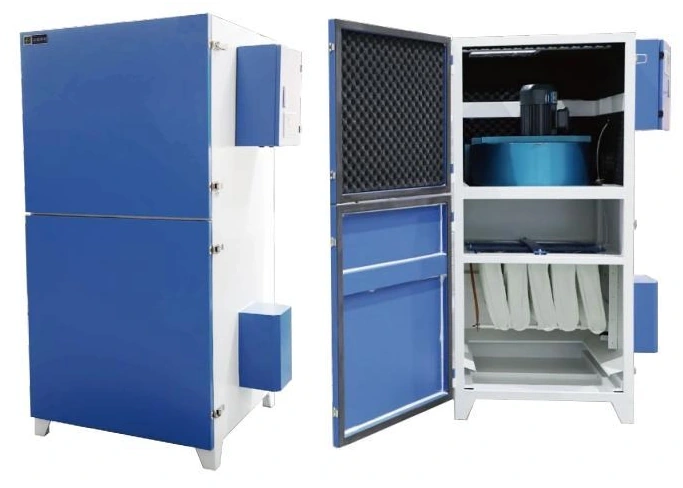
Dust Collectors
Bag Dust Collector
| Motor power | Airflow (m³/h) | Pressure (Pa) | External dimensions (mm) | Inlet Ø (mm) | Outlet (mm) |
|---|---|---|---|---|---|
| 0.75 kW | 1200 | 1210 | 600 × 600 × 1500 | 200 | 250 × 200 |
| 1.1 kW | 1600–1800 | 520–860 | 650 × 650 × 1600 | 200 | 250 × 200 |
| 1.5 kW | 1131–2356 | 606–994 | 750 × 750 × 1650 | 200 | 320 × 200 |
| 2.2 kW | 1688–3517 | 792–1300 | 800 × 800 × 1700 | 250 | 320 × 250 |
| 3 kW | 2664–5268 | 989–1578 | 850 × 850 × 1750 | 300 | 400 × 320 |
| 4 kW | 2750–5350 | 1100–1620 | 850 × 850 × 1800 | 300 | 400 × 320 |
| 5.5 kW | 4012–7419 | 1320–2014 | 950 × 950 × 2000 | 350 | 500 × 400 |
| 7.5 kW | 5712–10562 | 1673–2554 | 1050 × 1050 × 2050 | 350 | 500 × 400 |
| 11 kW | 7528–13800 | 1988–3000 | 1250 × 1250 × 2450 | 500 | 630 × 400 |
| 15 kW | 7728–15455 | 2019–3187 | 1250 × 1250 × 2550 | 500 | 630 × 400 |
| Filtration medium | Fabric filter bags | ||||
| Cleaning arrangement | Mechanical shaking mechanism | ||||
| Dust discharge | Lower collection drawer | ||||
| Customization | Collector configuration and connections to suit the process | ||||
Dimensions and configurations can be customized for your application.
Collect process dust through fabric filters in a compact extraction cabinet. Select the collector around the dust source, capture hood and operating duty—not motor power alone.
Capture dust before it disperses
The collector draws dust-laden air into the cabinet, separates particles on fabric filter bags and gathers released dust in the lower collection section. Bringing these components together can suit an individual machine or a defined extraction point where a large central system is unnecessary.
The cabinet is only one part of the capture arrangement. If the hood is too far from the source or points in the wrong direction, dust may escape before it reaches the duct. Start with how the process releases material, then place the capture point to intercept that movement.
Size the extraction path as a whole
The hood, duct length, bends and filter resistance all affect the flow available at the work. A short connection to one source behaves differently from a branched system serving several machines. Opening an additional branch can reduce extraction where it is needed most.
The listed airflow and pressure ranges describe selection information, not simultaneous maximum values at every operating condition. Choose a compatible operating point for the complete duct system. Keep access to joints and dampers so the installation can be balanced and checked after commissioning.
Let the dust determine the filter choice
Dry, free-flowing particles present a different filtration task from sticky, oily or moisture-bearing dust. Material that adheres strongly to fabric can resist cleaning and increase pressure loss. Temperature and chemical compatibility also affect the suitability of the bags and cabinet.
Do not treat the general-purpose arrangement as approval for combustible, explosive or highly toxic material. These applications require a specific hazard assessment and suitable protection measures. A standard cabinet should not be assumed to provide explosion relief, isolation or hazardous-dust containment.
Make cleaning and emptying part of the duty cycle
The shaking mechanism releases accumulated dust from the bags into the collection section. Its sequence needs to match the equipment arrangement and working duty. Plan when cleaning can take place and how the process responds during that period; do not assume that every cleaning action can occur while extraction demand remains unchanged.
Empty the drawer before accumulated material interferes with operation. The method should minimize disturbance of the collected dust and suit its hazards. Provide room to withdraw the drawer, inspect seals and reach the filter section without moving unrelated machinery.
Changes in suction, visible escape at the source or increasing resistance deserve investigation. Check blocked ducts, leaks and filter condition before simply increasing fan settings. Damaged bags and poorly seated seals need correction rather than a larger motor.
Connections, access and the collection arrangement can be customized around your process. Describe the dust, extraction points and operating schedule to select the collector configuration.