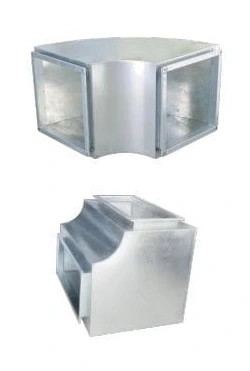
Acoustic duct elbow configurations
Cleanroom HVAC & Environmental Control
Duct Silencers
| Specification | Straight silencer | Acoustic elbow |
|---|---|---|
| Arrangement | In-line duct section | Change-of-direction duct section |
| Purpose | Duct-borne sound attenuation | Duct-borne sound attenuation at a bend |
| Dimensions | Selected to duct size and acoustic duty | Selected to bend geometry and acoustic duty |
| Connections | Coordinated duct flanges | |
| Acoustic selection | Frequency-dependent attenuation and pressure loss | |
Dimensions and configurations can be customized for your application.
Duct silencers reduce sound travelling through the ventilation air path. Straight and elbow arrangements allow acoustic treatment to be coordinated with a linear duct run or a required change in direction.
Treat the sound path that causes the problem
Noise can travel down a duct from a fan, pass between connected rooms or be generated by turbulent airflow at a fitting. A duct silencer addresses sound in that air path. It will not automatically solve vibration transmitted through a structure or sound radiating through a poorly isolated equipment casing.
Identify the dominant route before choosing the treatment. If the problem is duct-borne noise, the source spectrum and required room condition provide a better starting point than a single broad decibel target. A silencer's attenuation varies with frequency, so different sounds can require different arrangements.
Straight treatment
A straight silencer fits into a linear run and allows the acoustic section to be positioned in relation to the source and receiving space. Reserve enough length and access for the selected construction rather than squeezing the unit into a shorter gap after the duct route is fixed.
Transitions should approach it without creating severe flow distortion. Poor approach conditions can add pressure loss and generate noise that reduces the benefit of the acoustic treatment.
Treatment at a bend
An acoustic elbow combines attenuation with a necessary change in direction. It can be useful where the layout does not provide a convenient straight run. Its geometry still needs to suit the air duty and available space.
Do not select an elbow only because it occupies the desired corner. The internal passage and acoustic construction must be appropriate for the required airflow.
Balance attenuation with resistance
Sound reduction
Choose the required attenuation across the relevant frequency bands. A quoted overall reduction can hide weak performance at the frequency that matters most.
Pressure loss
Include the silencer in the fan duty. Excessive resistance can reduce delivered air or require a higher fan speed that creates more source noise.
Self-generated sound
Air moving through restricted passages can create additional sound. Check the selected unit at its actual airflow rather than judging it only by its physical length.
Keep the acoustic section suitable for the air stream
Consider dust, moisture and cleaning needs when selecting the internal construction. Where material shedding is a concern, coordinate the acoustic lining protection and the location relative to final filtration. Provide access where inspection or cleaning is expected.
Dimensions, straight or elbow arrangement and internal construction can be customized to the acoustic and ventilation duty. Discuss the noise source and available duct space.