Cleanroom Doors & Windows
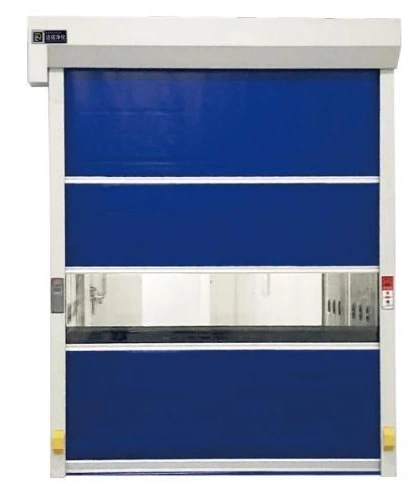
High-Speed Roll-Up Door
| Specification | JN-HSRD |
|---|---|
| Opening size | Custom-sized for the load, passage and installation space |
| Adjustable travel speed | 0.8–1.2 m/s |
| Frame options | Coated steel / brushed 304 stainless steel |
| Frame sheet thickness | 2.0 mm |
| Curtain | Reinforced PVC-coated fabric |
| Curtain thickness | 1.0 mm |
| Transparent vision section | 1.5 mm PVC |
| Drive control | Servo control |
| Protection and controls | Infrared photocell; safety bottom edge; emergency stop |
| Power supply | 220 V / 50 Hz |
| Activation options | Push button / radar / induction loop / pull cord / remote control |
Dimensions and configurations can be customized for your application.
A flexible roll-up door clears the opening vertically and closes after passage. It suits frequently used internal routes where reducing unnecessary open time and preserving approach space are important.
Reduce open time without interrupting movement
Between production areas, a door left open can allow unnecessary exchange of air, dust and drafts. A rapid vertical curtain provides a convenient opening for each transfer and then restores separation. The benefit depends on a suitable traffic sequence: fast movement alone is of little value if the opening is held continuously by a poorly placed sensor.
Map the approach, crossing and departure of the largest regular load. Set activation and closing behavior around that movement so operators do not have to stop abruptly or rush through. The transparent section helps people see activity beyond the closed curtain, but cannot remove a blind spot created by the load itself.
Use height and side space deliberately
The rolled curtain and drive occupy the area above the passage. Reserve headroom for the assembly and for servicing it, then keep pipes and cable trays out of the removal path. Side guides also need a sound fixing surface and clearance from nearby racks.
Include the highest part of the moving load, the handling device and floor transitions when defining the usable opening. A doorway measured from an unfinished slab can lose clearance after the floor is completed. Confirm which dimensions describe the clear opening and which describe the installed assembly.
Separate traffic from the sensing area
Radar, induction loops and manual activation suit different routes. A sensor covering a busy parallel aisle may repeatedly request opening even when no one intends to pass through. Choose its coverage around the actual approach rather than the largest possible detection area.
Protect the crossing, not just the curtain
Identify the load
Include low forks, protruding handles and trailing wrapping when assessing the passage. A detector positioned for a person may not cover every part of the handling equipment.
Agree fault behavior
Define the response to a blocked opening, interrupted supply and emergency stop. Staff should know how the installed door is released or isolated without improvising around moving equipment.
Check after impact
If a load strikes the curtain or guides, inspect alignment and operation before returning to normal use. Do not assume the curtain automatically recovers after every collision.
Choose the environmental boundary correctly
A flexible industrial curtain is not automatically a fire-rated door, a gas-tight barrier or a machine-guarding system. Match the selected assembly to the separation required at that opening. Where room pressure or cleanliness matters, coordinate seals and operating conditions with the ventilation design.
Provide the passage dimensions, traffic type, surrounding structure and desired activation. Curtain arrangement, opening size and controls can be customized to the operating scenario. Configure a roll-up entrance.