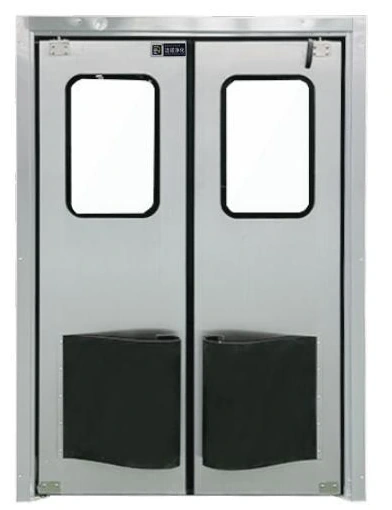
Cleanroom Doors & Windows
Double-Action Impact Door
| Specification | Single leaf | Double leaf |
|---|---|---|
| Wall opening (W × H, mm) | 900 × 2100 | 1500 × 2100 |
| Movement | Double-action, self-returning | |
| Surface options | Coated steel / brushed 304 stainless steel | |
| Frame sheet thickness | 1.2 mm | |
| Door skin thickness | 1.0 mm | |
| Leaf thickness | 50 mm | |
| Core options | Flame-retardant paper honeycomb / aluminium honeycomb | |
| Window size (W × H, mm) | 400 × 600; customizable | |
| Window glass | Double glazing with 5 mm toughened panes | |
| Hardware | Double-action hinges; return springs; protective rubber bumpers | |
Dimensions and configurations can be customized for your application.
A double-action impact door opens in either direction and returns towards the closed position after passage. It is intended for routes where repeated trolley and personnel movement would make conventional handle operation inconvenient.
Let the door move with the transfer
Moving supplies through a corridor can involve repeated stops to operate a handle and hold a leaf clear. A double-action door allows passage from either side, then uses its return mechanism to bring the leaf back. Protective contact areas help limit ordinary wear where suitable trolleys repeatedly meet the door.
The opening method is useful where two-way convenience matters. It is a different choice from a locked one-way entrance or a tightly controlled airlock. Select the door around traffic and separation requirements, without assuming an impact-resistant leaf provides an airtight or access-controlled boundary.
Protect the right part of the leaf
Impact protection works best when it meets the actual contact height of the moving equipment. A low trolley bumper, a projecting handle and a tall wheeled rack can strike different areas. Identify these points before fixing the size and position of the protective panels.
The door should accommodate normal controlled passage, not act as a stop for an uncontrolled vehicle. Check the trolley's loaded width, protrusions and turning path so contact occurs as intended. Repeated impacts against glazing, hinges or frame edges indicate that the route or protection arrangement needs attention.
Provide visibility in both directions
When a door can swing towards either side, someone on the opposite approach needs a useful view of oncoming traffic. Set the window height and size around the people and loads using the route. A tall carton may block the operator's view even when the door has a large glazed area.
Keep waiting and storage areas clear of both swing arcs. At a blind corner, an improved approach or separate traffic instruction may be more useful than a larger door alone. The finished opening must allow the leaves to move without striking a nearby wall or adjacent door.
Balance return action with daily use
A return mechanism that is too forceful makes passage difficult; one that does not reliably return the leaf leaves the opening exposed. Adjust the installed mechanism for the selected leaf and route, and observe its movement after a loaded trolley has passed.
Inspect the points that carry repeated movement
Hinges, return springs, bumpers and fixing points experience repeated loads. Check for a leaf that hangs unevenly, returns inconsistently or rubs against the frame. Replace damaged protective components before exposed edges begin marking carts or interfering with closure.
Cleaning access around the hinge and lower leaf should remain practical. Provide the trolley profile, contact heights, traffic direction and wall opening when specifying the door. Leaf arrangement, glazing and impact protection can be customized to suit the route. Discuss the passage and protection layout.