Cleanroom Doors & Windows
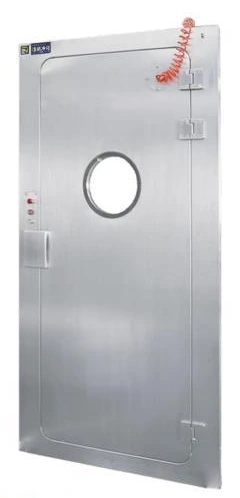
Biosafety Airtight Door
| Specification | JN-BSAD |
|---|---|
| Door opening and overall dimensions | Custom clear opening W × H and overall W × D × H, in mm |
| Door leaf and frame | 304 stainless steel |
| Sealing arrangement | Inflatable perimeter seal |
| Seal material | Silicone rubber |
| Door pressure differential rating | ±500 Pa |
| Viewing window | Round toughened glass |
| Status indication | Red: closed; green: passage permitted |
| Seal operation time | Inflation ≤5 s; deflation ≤5 s |
| Interlock | Configurable door interlock control |
| Power supply | 220 V / 50 Hz |
| Emergency release | Emergency unlock control; release sequence coordinated with the facility |
Dimensions and configurations can be customized for your application.
An inflatable seal closes the gap between the door leaf and frame after the door shuts. This door is designed for controlled laboratory boundaries where the opening, room pressure controls and access sequence must work together.
A closed door needs a continuous seal
In a controlled laboratory, a small perimeter gap can become an unintended air path. An inflatable seal expands against the closed door frame to reduce this leakage path; it retracts before the leaf moves, limiting rubbing during ordinary opening. The frame, seal corners, threshold and connection to the wall all contribute to the finished boundary.
This makes the door suitable for projects that need a defined sealing sequence. It does not create the room pressure regime by itself. The ventilation system establishes that regime, while the door controls coordinate when the boundary can be opened and restored.
Coordinate three interfaces before fabrication
The physical opening
Start with the largest item that must pass through, including its trolley, handles and protective wrapping. Check the usable opening after the frame and hardware are fitted, then reserve space for the leaf to open. A nominal wall opening alone does not describe the available passage.
The pressure boundary
Match the door orientation and wall fixing detail to the pressure direction and operating sequence. Frame movement or an uneven threshold can interrupt seal contact. The surrounding partition must support the assembly and maintain its own sealed joints.
The control boundary
Define door-closed, seal-ready, passage-permitted and fault states with the room control system. Agree which signal releases the next door and what happens after a failed sealing attempt, a power interruption or an emergency request.
Make everyday opening predictable
For normal access, the door must be closed and the required sequence completed before the boundary is considered restored. Before opening, the seal needs to retract and the access controls must permit movement. Clear status lights help operators avoid pulling against an engaged seal or repeatedly requesting access while another operation is incomplete.
Emergency access belongs in the design
Life safety and containment can impose different demands on an opening. Establish the emergency release behavior with the facility team, including loss of power or inflation supply. An interlock should support the approved access procedure without leaving personnel dependent on an unexplained control state.
Keep the sealing surfaces serviceable
Seal contact surfaces need to remain free from deposits, damaged edges and trapped material. Cleaning products should be checked against the silicone seal, stainless steel, glazing and electrical fittings as an assembly. A clean-looking surface is not evidence that a worn seal still closes correctly.
Allow access for seal replacement and inspection of the pneumatic connections. At handover, check the installed frame-to-wall joints and demonstrate normal access, interlocking, alarms and emergency release. Agree the required leakage test method and acceptance conditions for the installed boundary; a door specification alone does not qualify an entire laboratory.
Provide the wall construction, required clear opening, pressure-control arrangement and intended cleaning process when discussing the door. Opening size, installation details and control interfaces can be customized to suit the laboratory and its operating scenario.