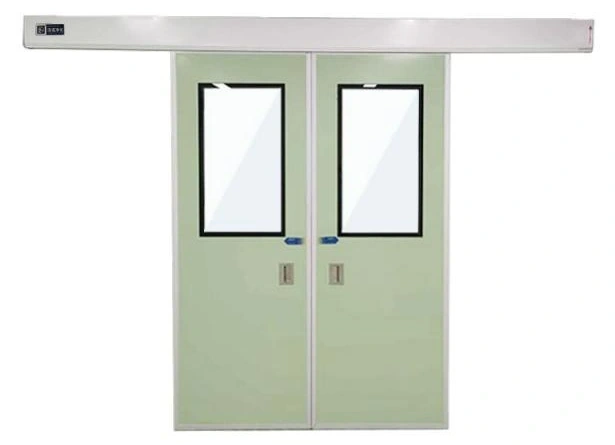
Cleanroom Doors & Windows
Automatic Sliding Cleanroom Door
| Specification | JN-ESD-01 | JN-ESD-02 | JN-ESD-03 |
|---|---|---|---|
| Wall opening (W × H, mm) | 900 × 2100 | 1200 × 2100 | 1500 × 2100 |
| Door movement | Single sliding leaf | Single sliding leaf | Bi-parting leaves |
| Track material | Aluminium alloy | ||
| Leaf surface options | Coated steel / brushed 304 stainless steel | ||
| Door skin / leaf thickness | 1.0 / 50 mm | ||
| Core options | Flame-retardant paper honeycomb / aluminium honeycomb | ||
| Window size (W × H, mm) | 400 × 600; customizable | ||
| Window glass | Double glazing with 5 mm toughened panes | ||
| Activation options | Infrared / radar / foot switch | ||
| Door protection | Infrared beam and obstruction-reversal function | ||
Dimensions and configurations can be customized for your application.
An automatic sliding door keeps a swinging leaf out of the approach route and allows passage without pulling a handle. Match the opening method and detection arrangement to the people, trolleys and equipment using the entrance.
Make passage easier without losing the boundary
Staff carrying materials often need both hands for the task. Automatic opening reduces the need to set an item down or handle a door, while sliding movement keeps the approach clear of a projecting leaf. This can be useful between preparation areas, laboratories and production spaces where traffic is frequent.
The opening still interrupts the separation between rooms. Position the door and choose its operating sequence around the traffic pattern, pressure relationship and length of time needed for passage. A longer hold-open time may help a slow-moving trolley, but also leaves the boundary open longer.
Reserve space beside and above the opening
A sliding leaf needs somewhere to travel. Check the side space for the full movement of the leaf, including guides and seals. Wall-mounted controls, pipes or a nearby cupboard can obstruct that path even when the wall opening itself is large enough.
The operator housing also needs access for adjustment and replacement. Coordinate its fixing with the wall construction and keep ceiling trims clear of the removable cover. The finished floor and wall surfaces should be established before final door alignment.
Single leaf or bi-parting?
A single leaf places its travel on one side of the opening. A bi-parting arrangement shares movement between both sides. Choose the arrangement around available wall space and the approach route, rather than treating the widest opening as automatically the best solution.
Give activation and protection distinct jobs
Request to open
Infrared, radar and foot-switch activation suit different working habits. A foot switch requires a deliberate action, while an approach sensor can respond automatically. Avoid locating activation where unrelated corridor traffic repeatedly opens the door.
Maintain passage
The detection arrangement must cover the people and loads actually passing through. Check low trolley components, trailing packaging and a person following a tall load, rather than assessing the entrance with an unladen walker alone.
Respond to interruption
Agree the behavior for an obstructed leaf, loss of supply and emergency access. Demonstrate the installed settings and release method to staff so a fault does not lead to forcing the leaves.
Keep routine service within reach
Clean visible guide areas and sensor surfaces using methods appropriate to the installed mechanism. Persistent reopening, uneven movement or contact with the frame should be investigated before adjustments become a substitute for worn or misaligned components.
For configuration, provide the wall opening, available side space, approach directions and typical loads. Leaf arrangement, glazing, activation and control interfaces can be customized to the facility's use. Plan an automatic entrance.