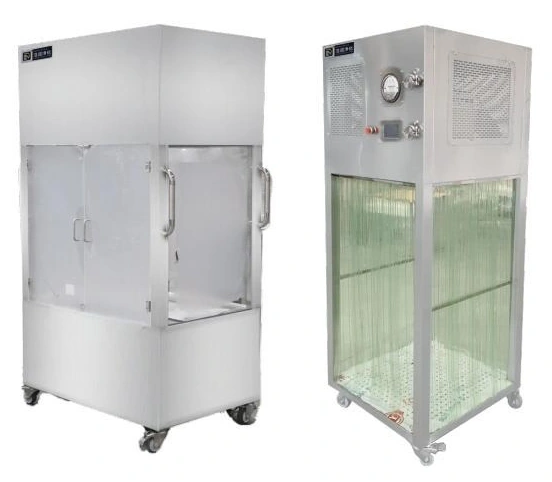
Clean Benches & Local Clean Air Systems
Mobile Sampling Cart
| Specification | JN-MSC |
|---|---|
| Dimensions | Customized to containers, working access and travel route |
| Frame | 304 stainless steel |
| Enclosure options | Acrylic, tempered glass, antistatic PVC curtain or PVC grid film |
| Mobility | Castors with brakes |
| Air velocity setting | 0.45 m/s ±20% |
| Power supply | 220 V, 50 Hz |
| Controls | Fan speed and lighting controls |
| Customization | Working enclosure, access and dimensions for the sampling task |
Dimensions and configurations can be customized for your application.
Bring a protected working area to the sampling location. The cart combines a movable frame with filtered air so that the sampling operation can be organized close to the material.
Take the workspace to the material
A fixed clean workstation is not always close to the containers that need sampling. Moving every container to it can add handling and create delays. A mobile cart offers a local working area that can be positioned at the intended sampling point, provided the surrounding conditions and process are suitable.
The useful benefit is a defined place to open the container, handle the sampling tool and close the sample. It does not remove the need to clean container surfaces, control packaging or identify samples correctly. Those steps remain part of the sampling method.
Move it closed and orderly
Secure loose tools and containers before moving. Check doorways, thresholds, turning space and floor condition along the route. A cart that clears a straight corridor may still be difficult to turn into its working position.
Park before opening material
Use the brakes and establish a stable position. Connect the required power, start the equipment and allow the agreed preparation procedure to complete before opening samples. Keep cables away from the working approach and trolley wheels.
Work within the protected zone
Keep the exposed sample under the filtered-air coverage and avoid obstructing the supply or return path with large containers. Place lids and sampling tools where they can be reached without passing dirty items over the sample.
Choose the enclosure for access and cleaning
Rigid transparent panels provide visibility and a defined boundary. Flexible curtains can accommodate movement and larger items, but repeated opening affects the local airflow and brings more surfaces into contact with the handling process. Select the panel arrangement with the actual container and tool movements in mind.
Antistatic material is an option for relevant applications, but a panel description alone does not establish an electrically safe system for every material. Review grounding, tools and process conditions together when electrostatic effects matter.
Separate mobility from continuous protection
The cart requires an appropriate electrical supply during operation. Movement between locations should not be assumed to preserve an active clean-air zone if the equipment is disconnected. Where the sample must remain protected during travel, that requirement needs an explicitly suitable transport arrangement.
This cart provides local product protection. Hazardous powders, infectious samples or volatile chemicals may require containment equipment with a different air strategy. Assess the material before deciding that a clean-air enclosure is the correct sampling station.
Clean the work area, handles and wheels using procedures appropriate to the spaces the cart enters. Recheck its operating condition after relocation, filter service or alterations to its enclosure. Dimensions, access panels and the working arrangement can be customized for your sampling process. Describe the containers, sampling steps and travel route to choose the configuration.