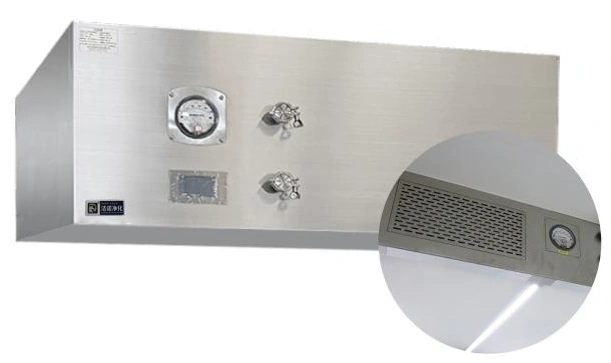
Clean Benches & Local Clean Air Systems
Laminar Flow Hood
| Specification | JN-LFH |
|---|---|
| Coverage and dimensions | Customized to the protected equipment and working area |
| Housing | 304 stainless steel |
| Air distribution face | Airflow distribution membrane or diffuser plate |
| Air velocity setting | 0.45 m/s ±20% |
| Mounting | Suspended installation or floor-supported frame |
| Power supply | 220 V, 50 Hz |
| Controls | Fan speed, lighting and UV lamp controls |
| Customization | Coverage, support arrangement and equipment interfaces |
Dimensions and configurations can be customized for your application.
Place the clean-air supply above the process that needs protection. A laminar flow hood can cover an existing machine or work area without replacing it with an enclosed bench.
Protect the exposed part of the process
Many machines have a small area where the product is exposed, even though the complete installation occupies a much larger floor space. A hood places filtered air above this critical area: an open handling station, a transfer position or a section of an assembly process.
The useful coverage is the area reached by the air after it passes the machine, tooling and operator. It is not simply the outline of the metal housing. A raised guard, cable tray or moving arm can interrupt the path, so the hood and the equipment should be reviewed together.
Coverage, working height and access belong together
A hood installed too high leaves more opportunity for surrounding air movements to influence the protected zone. One positioned too low can obstruct access, trap equipment beneath it or make changeovers awkward. The operating height should accommodate the complete task, including lifting lids, replacing tooling and removing finished items.
Consider the equipment in every operating position. A machine that fits beneath the hood when closed may move outside its coverage during loading. Keep exposed product beneath an unobstructed supply path during the vulnerable stage, and arrange personnel and material movements so they do not repeatedly cut through that path.
Suspended installation
Suspension can keep the floor around the process clear. Its supports need a suitable structural fixing and allowance for the housing, filters and service loads. Ceiling panels should not be assumed to provide the required support simply because the hood fits their layout.
Supported installation
A floor-supported frame can make the hood independent of the room ceiling. Position the legs around machine access, cleaning routes and maintenance withdrawal space. The frame should not introduce a new obstruction where an operator or trolley needs to approach the process.
Plan the service route before fixing the hood
Filters and fans eventually need access. Establish which panels are removed, how replacement components reach the hood and whether the process below must be isolated during service. Seals, diffuser surfaces and accessible joints also need a cleaning method compatible with the working environment.
A local filtered-air hood does not by itself control room temperature, humidity or all contamination entering with materials. Nor is downward clean air a substitute for hazardous-process extraction. Where the task releases dangerous dust, vapour or biological aerosols, protection requirements call for a suitable containment design.
Check airflow at the working zone after installation, using the actual equipment arrangement rather than an empty space beneath the hood. Changes to guards, room ventilation or machine layout can change the result. Coverage, mounting and controls can be customized for the application. Discuss the machine layout and exposed process to define a workable installation.