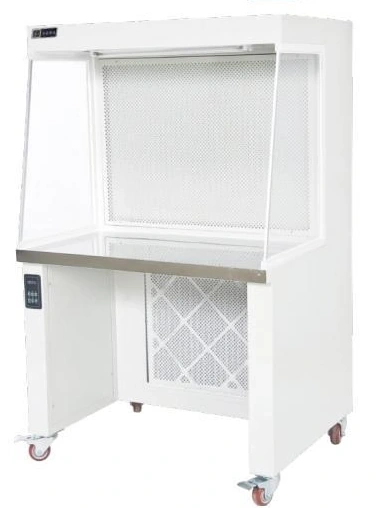
Clean Benches & Local Clean Air Systems
Horizontal Flow Clean Bench
| Specification | SW-CJ-1C | SW-CJ-2C |
|---|---|---|
| External size, W × D × H (mm) | 900 × 730 × 1450 | 1530 × 730 × 1450 |
| Working space, W × D × H (mm) | 860 × 480 × 640 | 1500 × 480 × 640 |
| Filter size (mm) / quantity | 820 × 600 × 50 / 1 | 600 × 630 × 50 / 2 |
| Housing | Coated steel | |
| Worktop | Brushed 304 stainless steel | |
| Air velocity setting | 0.45 m/s ±20% | |
| Power supply | 220 V, 50 Hz | |
| Controls | Fan speed adjustment; lighting and UV lamp switches | |
| Customization | Working dimensions and configuration to suit the process | |
Dimensions and configurations can be customized for your application.
Bring filtered air across the work from the rear of the bench. This arrangement is useful when the task benefits from an unobstructed horizontal air path and a clear view of the working surface.
Arrange the work in the direction of the air
Air travels from the rear filter towards the front opening. A component positioned close to a clear filter face receives the clean air before it passes across items farther forward. This makes layout a practical part of contamination control: the cleanest exposed operation should not sit behind a dusty container, an operator's hand or a large obstruction.
For small assemblies and inspection work, the open approach allows easy access without working beneath a low overhead filter housing. The benefit depends on preserving the horizontal path. Stacking trays against the filter or placing tall instruments across the bench can create sheltered regions and change the air pattern around the product.
Separate incoming materials from exposed work
Unpack transport materials before they reach the critical working area. Put frequently handled tools within reach without placing them directly upstream of sensitive surfaces. Keep finished work in a defined collection position so that each new item does not force the operator to reach across the previous one.
A wider bench needs a coordinated workflow
Additional width is useful for larger fixtures or distinct work stages. If more than one person uses the bench, agree the movement of hands, tools and product across the surface. Width alone does not prevent one operation from disturbing another. A trial arrangement with the actual equipment is more useful than choosing only by operator count.
Choose horizontal flow for the right material
This is a product-protection workstation for nonhazardous tasks. Air exits towards the front of the bench and the operator. It is not a suitable substitute for a biological safety cabinet when handling infectious materials, or for an extraction enclosure when handling toxic dust or volatile chemicals.
Also consider the product itself. Loose particles, very light components or an open weighing operation may react to the air stream. Positioning, fixtures and process requirements should be reviewed together. If the task cannot tolerate the horizontal flow or requires a different protection boundary, another workstation type may be more appropriate.
Keep access and maintenance straightforward
Locate the bench away from frequently opened doors and strong room cross-drafts. Allow access for filter service and electrical isolation instead of enclosing the rear and sides in permanent furniture. The installation should support stable operation as well as a comfortable working position.
Wipe the stainless worktop and accessible surfaces using a method compatible with the process. Do not brush debris into the filter face or use the filter as a backstop for equipment. After filter replacement, relocation or changes that affect airflow, verify the working condition before returning to exposed-product handling.
The working width, enclosure and process interfaces can be customized for the application. Share your assembly or inspection arrangement to select a practical bench configuration.