Clean Benches & Local Clean Air Systems
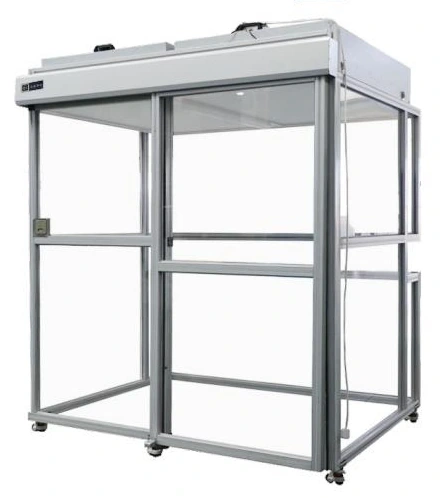
Clean Work Booth
| Specification | Configuration options |
|---|---|
| Dimensions | Customized to equipment and working-space requirements |
| Frame material | 304 stainless steel |
| Panel options | Acrylic, tempered glass, antistatic PVC curtain or PVC grid film |
| Air supply | Fan-driven high-efficiency filtered air |
| Air velocity setting | 0.45 m/s ±20% |
| Power supply | 220 V, 50 Hz |
| Controls | Fan speed and lighting controls |
| Customization | Enclosure, access and work-zone layout to suit the application |
Dimensions and configurations can be customized for your application.
Define a local clean working area around the task. A framed booth can protect exposed work inside a larger room while keeping the enclosure and access suited to the equipment.
A defined working zone inside an existing room
A booth brings the enclosure and filtered-air supply close to the exposed operation. It can be useful where a small assembly, inspection or handling area needs a cleaner local environment than the surrounding workshop provides.
Its boundary must suit the process. A booth with generous access can be easy to work in, but every opening also interacts with surrounding room air. The design should balance movement with the need to keep the sensitive work inside a stable protected zone.
Decide what belongs inside
Begin with the equipment used while the product is exposed. Include its working envelope, the operator's position and space for loading and unloading. Keep bulk packaging and storage outside where practical, so they do not consume the clean working area or introduce unnecessary particles.
Account for maintenance as well as production. A machine may need a side panel opened or a component withdrawn farther than expected. Access that is adequate for normal operation can still leave insufficient room for cleaning or repair. Position enclosure panels and entrances around these movements.
Rigid panels
Transparent rigid panels establish a consistent physical boundary and preserve visibility. Their joints, lower edges and door interfaces need to remain accessible for cleaning. Plan how larger equipment will be introduced before closing the frame around it.
Flexible access
Curtains offer practical access and can accommodate awkward items. Keep unnecessary movement through them to a minimum. A curtain pushed aside by a trolley or tied back throughout a task no longer provides the intended enclosure arrangement.
Leave a route for the air to leave
Filtered supply air needs a deliberate discharge or return path. Storage boxes, floor coverings and equipment placed against lower openings can change that path. Keeping the air route clear helps avoid local stagnation and prevents the booth from being treated as a sealed room without an engineered return arrangement.
Heat and moisture from equipment and occupants still need consideration. The fan-filter supply alone does not provide independent cooling, humidity control or all the services of a complete cleanroom. Check the existing room environment and the process requirements before deciding what additional services are needed.
Operate it as a workspace, not a guarantee
The achieved environment depends on the installation, enclosure openings, activity and maintenance. Check performance in the intended operating condition; do not infer a room classification merely from the filter type. Hazardous emissions require an appropriate containment strategy rather than reliance on a clean-air booth.
Define cleaning access, filter service and how the working area is prepared after interruptions. The booth dimensions, panels and access can be customized around the application. Share the equipment layout and exposed work to develop a practical local enclosure.