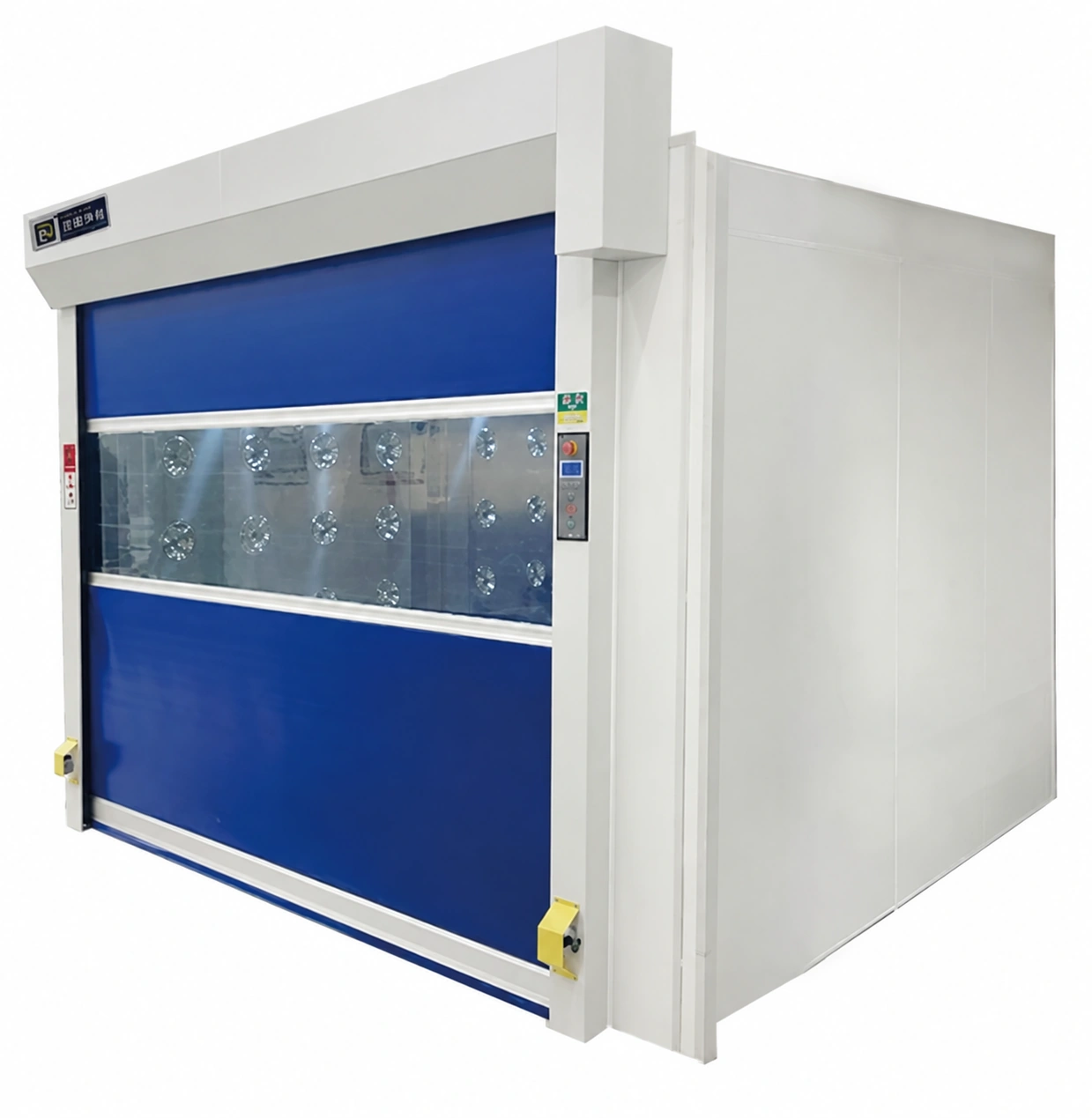
Cargo Air Showers
High-Speed Door Cargo Air Shower
| Specification | JN-HDFLS-E |
|---|---|
| External dimensions (mm) | 2000 × 2120 × 2500 |
| Working chamber dimensions (mm) | 1400 × 1900 × 2000 |
| Air nozzles | 24 |
| Fan power | 1.5 kW |
| Nozzle air velocity | ≥20 m/s |
| Blowing timer | 0–99 seconds, adjustable |
| Enclosure material | Brushed 304 stainless steel or coated steel |
| Door system | Powered roll-up doors with interlocked sequencing |
| Electrical supply | 380 V / 50 Hz |
| Controls | Infrared activation, cycle countdown and door interlock |
| Size customization | Available for the load, transport route and installation space |
Dimensions and configurations can be customized for your application.
Move trolleys and packaged materials through a dedicated particle-removal chamber with powered roll-up doors. The compact door movement helps keep the approach clear while interlocked operation separates loading, blowing and unloading.
Keep the doorway clear for material movement
A swinging door can occupy the same floor area needed to turn a trolley. A powered roll-up door moves above the opening, making this format useful where goods approach along a defined production route. It also reduces the need to handle a door while controlling a loaded cart.
The value comes from coordinating the whole crossing. Fast door movement alone does not determine throughput: positioning the load, closing the entry, completing the blowing cycle and clearing the receiving side all take time. Allow a waiting position outside the chamber so the next trolley does not interrupt the active transfer.
Start with the loaded trolley
Check the widest packaging overhang, highest load, handles and wheels as one moving envelope. A load that fits inside the chamber may still be awkward to turn into the entrance. The finished clear opening, approach angle and floor transition should be considered together, with space for the operator to move safely.
Arrange the load so the air can reach it
Directed jets help dislodge loose surface particles from exposed cargo and packaging. Closely packed boxes, deep recesses and the underside of a pallet receive different exposure from an unobstructed face. Select the nozzle arrangement around the actual load rather than assuming every surface receives the same cleaning action.
Keep return-air paths clear and avoid filling the chamber wall to wall. Remove loose wrapping or unstable labels before transfer: material that detaches during blowing can obstruct the air path or contaminate the next load. This equipment supports a defined material-entry routine; it does not wash away oily deposits or sterilize the contents of sealed packages.
Make each stage of the crossing unambiguous
Load
The entry opens while the receiving door remains closed. The load moves fully into position, clear of the door travel and detection zones.
Blow
With the doors closed, the timed air cycle runs. A clear countdown helps prevent an operator from treating a closed door as a fault or trying to force it.
Release
The receiving-side release follows the completed sequence. Obstruction, emergency-stop and restart behavior must be coordinated with the surrounding transport equipment.
Door activation and obstruction protection have different functions. Agree how the selected sensing devices respond to low trolley frames, narrow projections and a stopped load, and verify the complete arrangement at installation.
Plan for the days when the route needs attention
Leave access to the door drive, guides, fan and filters. Guards and nearby production equipment should not prevent a technician from reaching these parts. Inspect door alignment and seals after impacts, and keep the floor transition smooth enough that wheels do not strike or lift the load during entry.
For a matched configuration, provide the loaded trolley outline, direction of travel, available opening and expected arrival pattern. Chamber dimensions, door arrangement and controls can be customized to suit your operating scenario. Discuss your cargo route.