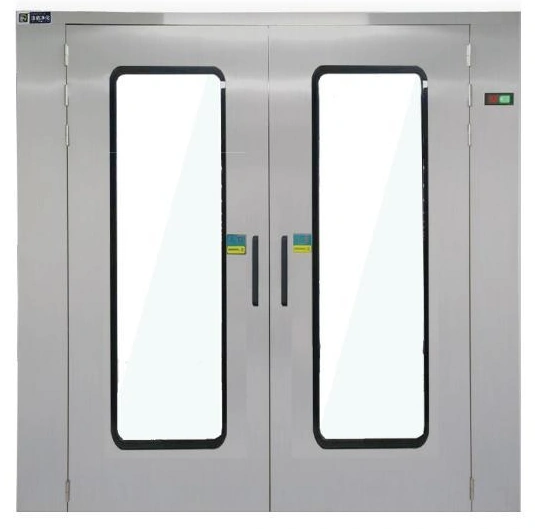
Cargo Air Showers
Cargo Air Shower
| Specification | JN-HLS-C |
|---|---|
| External size (W × D × H, mm) | 2000 × 2000 × 2100 |
| Chamber size (W × D × H, mm) | 1400 × 1900 × 2000 |
| Air nozzles | 24 |
| Fan power | 1.5 kW |
| Enclosure material options | Brushed 304 stainless steel / coated steel |
| Door and frame material | Brushed 304 stainless steel |
| Viewing glass | 5 mm toughened glass |
| Filtration | Prefilter and high-efficiency filter |
| Nozzle outlet velocity | ≥20 m/s |
| Blowing time adjustment | 0–99 s |
| Power supply | 380 V / 50 Hz |
| Controls | Infrared activation; door interlock; LED lighting |
| Size customization | Chamber and openings configured to the material-handling route |
Dimensions and configurations can be customized for your application.
A cargo air shower provides an enclosed blowing stage for materials entering a clean area. Its layout should fit the complete moving load and expose the surfaces that need attention while keeping material movement separate from personnel entry.
Start with the load in its moving condition
A carton dimension is only part of a material-handling route. The load may travel on a trolley with projecting handles, a pallet with overhanging wrapping, or a wheeled vessel that needs room to turn. Measure the whole assembly in the condition in which it will enter the shower, including the person or handling device moving it.
The working chamber and the clear door opening are different dimensions. Both must accommodate the chosen route. A load that fits inside can still be difficult to pass through the frame, position away from the nozzles or remove without striking the exit.
Give the jets a useful path to the surface
Air jets act on exposed surfaces. Tightly packed stacks, deep recesses and items hidden behind other containers receive a different exposure from an unobstructed outer face. Plan the loading pattern around the surfaces that matter rather than assuming that placing an object in the chamber treats every part equally.
Leave return grilles unobstructed so displaced particles can move towards the filters. Loose wrapping can flutter in the airflow or cover a grille; remove unnecessary outer packaging at the appropriate upstream station and secure what remains.
Decide whether blowing suits the material
Dry, loose surface contamination is a different problem from an oily film, sticky residue or contamination inside a sealed package. Air blowing does not replace a material-specific cleaning or decontamination process. Fragile assemblies, loose powders and easily displaced components need a suitability review before this transfer method is selected.
Plan the route through both doors
Before entry
Provide enough approach space to align the loaded trolley. Keep waiting materials clear of the door swing and avoid turning immediately against the entrance frame.
During the cycle
Position the load so both doors can close fully. Define whether the operator remains in the chamber or uses a separate route, and arrange the controls accordingly.
At the clean-side exit
Reserve receiving space for the entire load. A blocked exit encourages unnecessary waiting or repeated door operation and can interfere with the next transfer.
Maintain a reliable transfer point
Repeated trolley movement makes the floor transition, frame edges and lower panels important inspection points. Choose an installation detail that suits wheel sizes, floor levels and the intended load, and verify floor support separately; cabin dimensions do not establish a load-bearing rating.
Keep access to filters, fans and electrical controls available after installation. A service panel trapped behind a production line makes routine maintenance unnecessarily disruptive. Include normal door operation, interlock behavior and the intended material position in the handover checks.
For a suitable configuration, provide the maximum loaded envelope, handling method, approximate transfer frequency, floor arrangement and the material's cleaning requirements. Chamber dimensions, entry details and controls can be customized to the cargo route and its operating scenario.