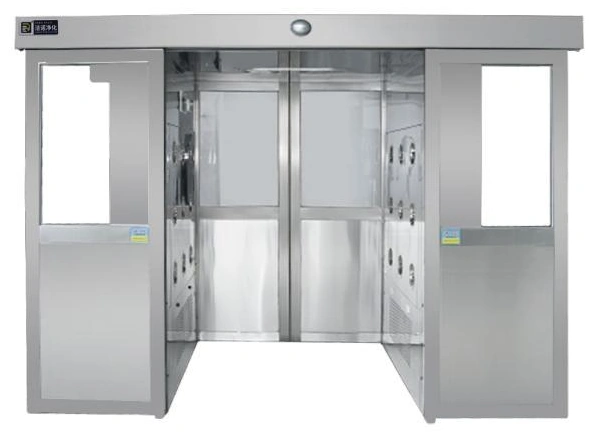
Cargo Air Showers
Automatic Sliding Door Cargo Air Shower
| Specification | JN-ADFLS-D |
|---|---|
| External size (W × D × H, mm) | 2000 × 2100 × 2200 |
| Chamber size (W × D × H, mm) | 1400 × 1900 × 2000 |
| Door arrangement | Automatic sliding doors with external track and drive |
| Air nozzles | 24 |
| Fan power | 1.5 kW |
| Enclosure material options | Brushed 304 stainless steel / coated steel |
| Door and frame material | Brushed 304 stainless steel |
| Viewing glass | 5 mm toughened glass |
| Filtration | Prefilter and high-efficiency filter |
| Nozzle outlet velocity | ≥20 m/s |
| Blowing time adjustment | 0–99 s |
| Power supply | 380 V / 50 Hz |
| Controls | Infrared activation; adjustable blowing timer; interlocked doors; LED lighting |
Dimensions and configurations can be customized for your application.
Automatic sliding doors make cargo entry easier when a handler needs to keep control of a trolley or load. The surface-mounted mechanism remains accessible, while the chamber and door controls coordinate the transfer from one side to the other.
Reduce the need to stop and handle a door
A handler pushing a loaded trolley should not have to release it, reach around a carton and pull a door into the route. Automatic sliding operation can make that movement more direct. The leaves move sideways rather than swinging across the approach, allowing the operator to concentrate on alignment and load control.
This arrangement uses an externally mounted track and drive. That provides a different maintenance approach from a concealed entrance: the mechanism is accessible from the surrounding area, but its housing and leaf-travel space must remain clear. Nearby racks, pipework and wall-mounted equipment need to be coordinated with that space.
Opening detection and safe passage are separate tasks
An opening sensor requests movement when a user or load approaches. It does not, by itself, define protection for every object in the doorway. The selected detection arrangement must suit the real traffic, including low trolley frames, projecting handles, transparent packaging and people walking close behind a load.
Approaching
Position activation so the handler can reach the doorway without abrupt stopping. Check the approach from the direction actually used by the trolley, not only a person walking straight towards the sensor.
Crossing
Specify how the opening remains available while the full load passes. Include trailing wrapping and an operator following the trolley in the assessment of the doorway and moving-leaf zones.
Interrupted movement
Agree the response to a blocked door, a failed close signal or a loss of power. Demonstrate the installed response before the route is placed into routine operation.
Coordinate the automatic doors with the blowing stage
The entry must close before the chamber begins its intended cycle. After the blowing stage, the exit becomes available for transfer to the receiving area. Door interlocking helps control the sequence between the two sides; it should not be confused with moving-door obstruction protection.
Decide where the handler stands during treatment and whether the route is intended for material alone or material accompanied by a person. Arrange a clear receiving area so the load can leave completely before the next transfer is requested.
Expose the surfaces that matter
Filtered jets act on accessible outer surfaces. A densely wrapped load or a surface shielded by another container will not receive the same exposure as an open face. Select the loading pattern and any upstream unpacking or cleaning around the actual material, without relying on blowing to sterilize the load.
Keep the drive accessible throughout its service life
The exposed arrangement allows planned inspection of the door mechanism, but it also requires a cleaning and maintenance route. Avoid placing permanent storage beneath removable covers. Include sensors, guides, rollers, door edges and interlock operation in routine checks alongside the chamber's filters and air returns.
Provide the loaded trolley dimensions, approach direction, transfer frequency, available wall space and the preferred control sequence when discussing the unit. Door openings, chamber layout and control interfaces can be customized to suit the handling process and installation scenario.