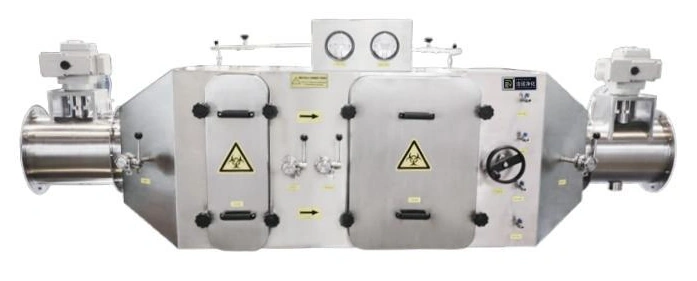
Bag-In/Bag-Out Filter Housings
Bag-In/Bag-Out Filter Housing
| Specification | Configuration options |
|---|---|
| Housing material | 304 stainless steel or coated steel |
| Installation format | Horizontal or vertical |
| Overall dimensions | Custom W × D × H in mm for airflow, filter stages and duct interfaces |
| Final filter option | H14 |
| Filter access | Bag-in/bag-out service ports |
| Closure | Gasket seal with mechanical clamping |
| Monitoring | Differential pressure indication |
| Aerosol test connections | SUS 304 sampling ports |
| Filter scanning | Manual or automatic scanning arrangement |
Dimensions and configurations can be customized for your application.
A sealed filter enclosure designed around both filtration and filter replacement. The bagging interface keeps the used filter within a controlled handling barrier while service access, isolation and test connections support the wider maintenance process.
Plan for the filter after it has collected contamination
In a containment ventilation system, the material retained by a filter does not disappear when the fan stops. Opening an ordinary access panel can expose the filter face and surrounding surfaces during removal. A bag-in/bag-out housing provides a dedicated bagging connection so that filter replacement can take place within a barrier rather than across an open service doorway.
The housing therefore belongs in the ventilation design from the beginning. It affects filter access, duct isolation, pressure monitoring, testing and waste handling. Adding a bag to a standard filter cabinet later does not create the same coordinated arrangement.
Three spaces must fit
- The installed housing: allow room for ducts, supports, gauges, isolation devices and the selected filter stages.
- The service envelope: the bag must extend, the filter must move clear of its seat, and the operator needs a workable position.
- The removal route: the supported, enclosed used filter must reach the designated waste container without being dragged across surrounding equipment.
A housing that fits neatly against a wall can still be impossible to service if the access side faces a pipe rack. Review the maintenance position on the layout drawing, including a handling support for the filter mass. Specify the access direction before finalizing nearby services.
Separate pressure monitoring from integrity testing
Pressure trend
Differential pressure helps track the resistance of the installed filter stage. Interpret readings with the operating airflow: a different fan setting or closed damper can change the reading without a corresponding change in filter loading.
Installed integrity
Aerosol injection, sampling and scanning access support examination of the installed filter and its seal. The filter grade alone does not prove that the complete housing installation has no bypass leakage. Test connections must be reachable after the surrounding plant is installed.
Return to service
Replacement requires the correct filter dimensions and sealing arrangement, restoration of closures and the specified checks before ventilation resumes. Keep replacement filter and bag information with the equipment records so service staff can obtain compatible parts.
Match filtration to what is in the air
A particulate filter stage collects airborne particles; it does not establish removal of gases or vapours. Identify the contaminant, airflow, expected dust load and exposure-control objective before selecting the filter arrangement. Additional treatment, prefiltration or decontamination requirements depend on that duty.
The bagging barrier is one part of a controlled change procedure. System isolation, decontamination where required, suitable protective equipment and waste arrangements must be defined for the actual hazard. Operators need the housing-specific service instructions and training; a bagging port by itself is not a complete safety system.
For a quotation, provide duty airflow, available fan pressure, duct connection sizes, required filter stages and the proposed service side. Housing dimensions, access orientation, test arrangements and duct interfaces can be customized to suit your installation. Discuss the filter housing configuration.