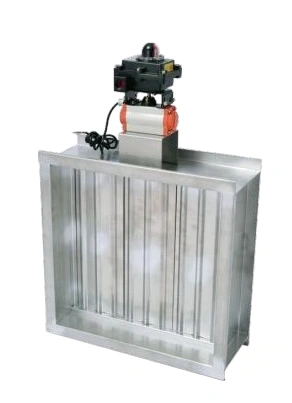
Airtight Isolation Dampers
Pneumatic Airtight Damper
| Specification | Pneumatic configuration |
|---|---|
| Actuation | Compressed-air actuator |
| Function | Duct isolation / shut-off |
| Duct form | Rectangular flanged connection |
| Material options | Galvanized steel / stainless steel |
| Dimensions | Matched to the duct and installation space |
| Controls | Actuator and position feedback selected to the sequence |
Dimensions and configurations can be customized for your application.
A pneumatic airtight damper uses compressed-air actuation to operate a sealed duct closure. It suits systems where the isolation function needs to be integrated with a pneumatic utility and a defined operating sequence.
Isolate the branch with a defined sequence
An isolation damper is selected for its closed-state function as well as its ability to open. It can separate a branch during a planned operating mode or support a coordinated equipment sequence. Pneumatic actuation is useful where compressed air is already available and the control architecture is built around pneumatic devices.
The term airtight identifies the sealing purpose of the product. The required leakage performance still needs to be defined at the relevant pressure and for the actual assembly. Choose the seal, body and test requirement together rather than treating all sealed dampers as interchangeable.
Plan for both air and signal loss
The actuator needs a suitable compressed-air supply and an appropriate valve arrangement. Consider air quality, available pressure and tubing access when locating the damper. Restricted or unreliable air delivery can slow travel or prevent the mechanism from reaching its intended end position.
Define what should happen if the control signal or utility air is lost. The required behaviour depends on the application and actuator arrangement. A return spring or stored-air strategy should be specified where needed rather than inferred from pneumatic operation alone.
Confirm the physical position
A command to close is not proof that the closure has seated. Where the process depends on isolation, coordinate position indication with the operating sequence. Feedback should confirm the intended mechanism position rather than merely report that an electrical command was sent.
Protect the sealing surfaces
Keep the duct connection aligned and independently supported. A distorted body can change blade clearance and contact at the seals. During commissioning, operate the damper through its travel and inspect for obstruction or uneven seating before applying the final control sequence.
Dust accumulation, deposits and incompatible cleaning chemicals can affect sealing surfaces over time. Make the inspection points accessible and select materials for the actual air stream. Where the air contains aggressive vapours or process residues, the seal material deserves as much attention as the visible metal body.
Fit the isolation requirement to the installation
Identify the operating pressure, air-stream condition, opening size and required closed-state performance. Include the intended normal position, response to utility loss and any equipment interlocks. This gives the damper a clear role in the system and avoids later changes to the actuator or controls.
Body dimensions, materials, actuation and feedback arrangements can be customized to the application. Discuss the required isolation sequence.