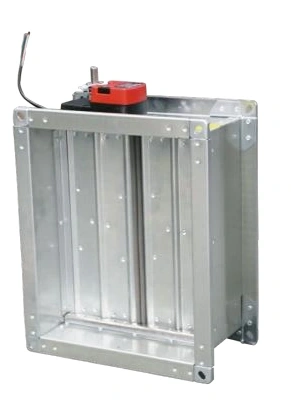
Electric volume control damper
Air Volume Control Dampers
Electric Volume Control Dampers
| Specification | Electric damper |
|---|---|
| Actuation | Electric motor actuator |
| Blade arrangement | Linked rectangular blades |
| Body material options | Galvanized steel / stainless steel |
| Connection | Flanged duct connection |
| Dimensions | Matched to the duct opening |
| Control interface | Selected to the project control sequence |
Dimensions and configurations can be customized for your application.
Electric volume control dampers adjust a duct opening using a powered actuator. They allow a ventilation control system to change branch airflow without requiring an operator to reach a manual handle above the ceiling.
Move the damper where the system needs it
A powered damper is useful when airflow needs to change with occupancy, operating mode or a process demand. The actuator moves linked blades to vary the open passage. This provides a controllable restriction in the branch and allows the response to be coordinated from the ventilation controls.
Blade position is not the same as measured airflow. The volume through a partly open damper also depends on duct pressure and conditions elsewhere in the system. If the requirement is a defined air volume rather than a blade position, include the appropriate measurement and feedback arrangement.
Choose the actuator around the job
Movement
Decide whether the application needs open/close operation or continuous modulation. A simple switching actuator should not be selected for a control loop that needs intermediate positioning.
Available torque
Match the actuator to the blade mechanism and operating pressure. A motor that moves an unloaded damper on a bench may struggle against the installed air pressure or a distorted casing.
Loss of power
Define the required position when power or control is lost. A spring-return requirement must be selected explicitly; it should not be assumed from the fact that the damper is electric.
Leave room for the mechanism
The actuator, linkage and wiring need service space outside the duct. Position them where an operator can inspect movement, access terminals and replace the actuator without dismantling adjacent services. Check access after insulation and ceiling work, not only while the bare duct is visible.
Support the duct and keep the flange square. Installation loads can distort the body and make otherwise adequate blades bind. Check full travel before connecting the unit to automatic operation, and confirm that the indicated end positions correspond to the actual blade positions.
A stable control response
Repeated hunting can result from an unsuitable control sequence, excessive pressure or poor measurement location. Review the whole loop before reducing travel or forcing the damper to one position. Where multiple branches change together, the fan-pressure control and branch controls should be coordinated.
Provide the duct opening, air duty, available power and intended control sequence for selection. Body size, actuator and connection arrangement can be customized to the installation. Discuss the damper control requirement.