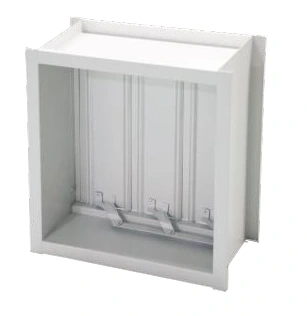
Air Volume Control Dampers
Backdraft Damper
| Specification | Rectangular backdraft damper |
|---|---|
| Function | Reverse-airflow control |
| Blade arrangement | Multiple linked or freely moving closure blades, as selected |
| Duct connection | Rectangular flanged opening |
| Dimensions | Matched to the branch opening |
| Installation orientation | Selected for the intended airflow direction and mounting position |
Dimensions and configurations can be customized for your application.
A backdraft damper allows airflow in the intended direction and closes when flow reverses or the forward driving force falls away. It helps separate an operating ventilation path from unwanted reverse circulation.
Stop the idle branch becoming a return path
When a fan stops, pressure elsewhere in a duct system can push air back through its branch. This can cause unwanted circulation, cold-air entry or interaction between parallel branches. A backdraft damper places a directional closure in that path so the blades respond to the airflow direction.
It is useful to identify the source of reverse pressure before choosing the damper. Wind at an external opening, another operating fan or a pressure difference between rooms can produce different conditions. The selected closure needs to suit those conditions as well as the normal forward flow.
Opening pressure is part of fan selection
The air must overcome the resistance of the moving blades as they open. At a low forward flow, a damper may remain only partly open or move unsteadily. Account for its resistance in the fan duty and select an arrangement suited to the expected operating range.
A larger duct opening does not automatically solve unstable blade movement. The blade geometry, operating orientation and available pressure also matter. Where noise or flutter occurs, inspect the approach flow and operating point before adding weights or altering the mechanism.
Mount it in the intended direction
Gravity and blade balance can form part of the closing action. Confirm the airflow arrow and permitted mounting position for the selected assembly. Rotating a damper to fit an awkward duct route can change its behaviour even when the flange still fits.
Keep the blades free to move
Allow clear space for blade travel and keep screws, insulation and adjacent duct components out of the sweep. Support the frame squarely so that the blades do not rub after the flange bolts are tightened. Check movement in the installed position rather than only before mounting.
Dust, grease or sticky process deposits can gradually change the opening and closing behaviour. Provide service access that allows the blades and pivots to be inspected and cleaned. For exterior connections, coordinate weather protection separately; a directional damper is not automatically a rain louvre.
Choose it for directional control
A backdraft function should not be confused with a certified fire barrier or a specified low-leakage isolation assembly. Where tight shut-off is needed, define that requirement separately and choose an appropriate product. Opening size, blade arrangement and mounting details can be customized to the ventilation application. Discuss the reverse-flow condition.