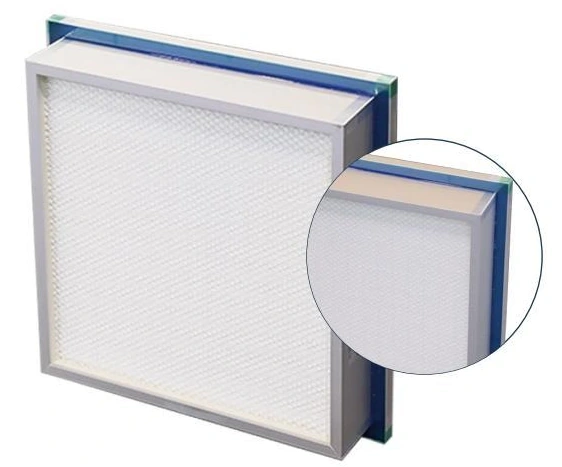
Air Filters
Side Gel Seal HEPA Filter
| Specification | 400 × 400 | 550 × 550 | 630 × 630 | 945 × 630 | 1260 × 630 |
|---|---|---|---|---|---|
| Series | JN-SGSHP | ||||
| Overall size (W × H × D, mm) | 400 × 400 × 90 | 550 × 550 × 90 | 630 × 630 × 90 | 945 × 630 × 90 | 1260 × 630 × 90 |
| Nominal airflow (m³/h) | 500 | 1000 | 1500 | 2000 | 3000 |
| Filter grade | H14 | ||||
| Frame / media | Aluminium alloy / microglass fibre | ||||
| Pack construction | Hot-melt spacing; polyurethane potting | ||||
| Face protection | Coated steel mesh | ||||
| Seal interface | Side gel channel | ||||
| Maximum operating temperature / humidity | 80°C / 80% RH | ||||
Dimensions and configurations can be customized for your application.
A side gel seal filter combines a pleated media pack with a sealing channel at the frame interface. It is selected as a matched part of the terminal housing, so air passes through the filter rather than around its perimeter.
Match the seal profile before ordering a replacement
A filter can have the correct face dimensions and still be unsuitable for the housing. With a side gel seal, the channel position, mating profile and engagement depth must correspond to the installation. Replacing it with a gasket-sealed panel of similar size changes that interface.
Record the full frame dimensions, the side-channel detail and the housing arrangement before selection. The installation drawing should show how the seal engages and how the filter is supported, rather than relying on the description “gel seal” alone.
Media and perimeter perform different jobs
The media captures particles carried through the pack. The frame-to-housing interface controls the bypass route around it. Damage or poor seating at either location can compromise the installed result, so a grade label does not replace inspection of the complete assembly.
Consider the airflow at the filter face
Choose the face area around the required air volume and the available terminal arrangement. Increasing flow through an unchanged panel can increase resistance and alter distribution at the outlet. Compare the required duty with the pressure available from the system rather than selecting only by the physical opening.
The filter, diffuser and upstream connection work together. Restricted duct entry or a poorly arranged plenum can produce uneven conditions across the face. Review these interfaces when an otherwise suitable replacement fails to restore the expected room airflow.
Keep the sealing channel and media protected
Before fitting
Keep the panel protected until the housing is ready. Examine the frame and sealing channel for transport damage, loose material or contamination that could interrupt the mating surface.
During handling
Support the panel by its frame. The face guard helps protect the pack but is not a lifting surface, and pressure through the mesh can still damage the media beneath it.
At completion
Check seating and the agreed installed-integrity requirements. A suspected leak may involve the frame, housing or seal as well as the media; identify the cause before replacing parts.
Plan access for the next change
Provide room to release and remove the panel without dragging it across surrounding equipment. The size of the access opening and the handling route should be checked with the largest filter used in the system, not just the smallest panel.
Share the existing housing drawing, sealing profile, required flow and environmental conditions. Filter dimensions and the side-seal arrangement can be customized to the terminal system. Check filter-to-housing compatibility.