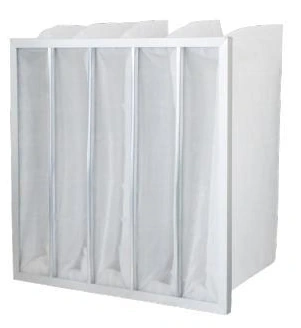
F5-designated configuration
Air Filters
Pocket Air Filters
| Specification | F5 designation | F6 designation | F7 designation | F8 designation |
|---|---|---|---|---|
| Media construction | Synthetic-fibre composite | |||
| Frame options | Aluminium alloy / galvanized steel | |||
| Filter form | Multi-pocket | |||
| Face dimensions and pocket depth | Configured to the housing and airflow | |||
| Grade selection | Confirm required test classification for the application | |||
Dimensions and configurations can be customized for your application.
Pocket filters extend media into a series of bags behind the frame. This provides more filtration area than a flat panel within the same face opening, provided the housing gives the pockets room to open and carry the required airflow.
Use the depth behind the filter face
The bags extend into the air path and provide additional media surface. This can support a useful intermediate filtration stage in ventilation equipment, reducing the particulate burden reaching downstream components or final filters. The pocket arrangement must have sufficient room to develop its intended shape.
A housing that accepts the header frame may still be too shallow for the bags. Check clearance from coils, dampers, turning vanes and neighbouring filters. Compressed or obstructed pockets cannot use their full surface as intended and may load unevenly.
Select the duty before selecting the label
The required filtration level should follow the incoming air, the downstream equipment and the purpose of the space served. A higher-sounding grade label alone does not show the right choice. Compare performance information for the selected filter at its intended operating conditions, including resistance and the fan's pressure allowance.
The F5, F6, F7 and F8 designations shown here use older naming conventions. They are not a direct substitute for an ISO 16890 classification. Where the project specifies ePM performance, use the corresponding test information for the actual construction instead of assigning an assumed conversion.
Resolve three practical fit questions
Does the frame seal?
Match the header dimensions and retaining system, including any gasket arrangement. A gap around the header permits untreated bypass air regardless of the media selected.
Can the bags open freely?
Check pocket depth, spacing and orientation against the housing layout. Allow for the operating shape and keep downstream obstructions away from the bag ends.
Can it be changed cleanly?
Leave room to withdraw the loaded filter without dragging bags across sharp edges. The service route should accommodate its depth and the contamination collected during operation.
Watch condition as well as pressure
Loading changes the resistance seen by the fan. Monitor the system using its approved maintenance criteria, while also inspecting for damaged pockets, loose seams and poor seating. A torn bag may not produce the pressure behavior expected from an intact but loaded filter.
Keep stored filters protected from damage and moisture. These synthetic-media pockets should not be assumed washable because the frame is metal; the cleaning suitability of the complete construction must be established separately.
Prepare a complete selection
Useful information includes the housing face size, available depth, airflow, pressure allowance, expected particles and required test classification. Frame dimensions, pocket geometry and media selection can be customized to the ventilation application. Discuss a pocket-filter configuration.