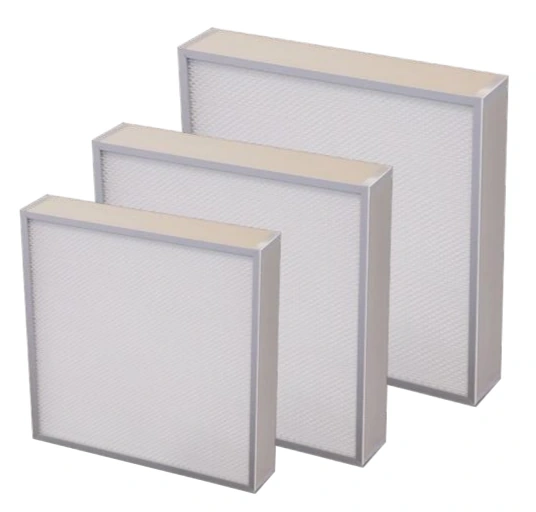
Air Filters
Mini-Pleat HEPA Filter
| Specification | 320 × 320 | 484 × 484 | 630 × 630 | 945 × 630 | 1260 × 630 |
|---|---|---|---|---|---|
| Series | JN-MPHF | ||||
| Overall size (W × H × D, mm) | 320 × 320 × 90 | 484 × 484 × 90 | 630 × 630 × 90 | 945 × 630 × 90 | 1260 × 630 × 90 |
| Nominal airflow (m³/h) | 300 | 700 | 1500 | 2000 | 3000 |
| Grade options | H13 / H14 | ||||
| Frame / media | Aluminium alloy / microglass fibre | ||||
| Pleat spacing / potting | Hot-melt / polyurethane | ||||
| Seal | EPDM gasket | ||||
| Face protection | Coated steel mesh | ||||
| Maximum operating temperature / humidity | 80°C / 80% RH | ||||
Dimensions and configurations can be customized for your application.
A mini-pleat filter uses closely spaced media folds held apart by hot-melt separators. The shallow panel format places a substantial filtration surface within a compact frame for compatible terminal units and clean-air equipment.
Use limited terminal depth effectively
The mini-pleat construction folds the filter medium into a compact pack, with hot-melt spacing keeping adjacent pleats apart. It avoids the deeper corrugated separator structure used in another type of HEPA filter. This can make the panel suitable where the terminal or clean-air device has limited depth.
Compactness is useful only when the panel matches the housing and air duty. The available plenum, fan capability and outlet arrangement still determine whether the assembled unit can deliver the required airflow. A thinner-looking filter is not automatically an equivalent replacement for a different construction.
Choose the grade and airflow together
Different media selections can change the resistance presented to the fan. Select the required grade from the process need, then check the operating airflow and pressure available in the equipment. Choosing a higher grade without considering the fan may change the delivered air quantity.
For replacements, record the original panel size, gasket location, grade and intended duty. Face dimensions alone do not establish equivalence. If several units share a room, an unmatched replacement can also affect the balance between them.
Three checks at the gasketed interface
A continuous contact surface
The housing seat should be clean, undamaged and suitable for the gasket profile. A dent or trapped debris can create an unintended bypass path around otherwise intact media.
Correct support
The frame needs even support from the designed fixing arrangement. Do not use extra clamping force to compensate for an incorrect depth or a distorted frame.
Access for verification
Where the process requires installed leak checking, reserve access to the filter face and perimeter. The test arrangement should be considered with the terminal design, not after equipment blocks it.
Protect a delicate component during service
The guard mesh provides a protective face, but tools and fingers can still damage the media through it. Lift and position the panel by the frame, keep it packaged until required and protect it from construction dust before commissioning.
Upstream filtration and regular attention to the air system help avoid unnecessary loading of the final filter. Replacement decisions should consider the equipment's pressure allowance, condition and process requirements rather than a universal calendar interval.
Prepare a compatible specification
Provide the equipment or housing detail, desired grade, operating flow and gasket arrangement. Dimensions and filter configuration can be customized to the clean-air application. Select a mini-pleat panel.