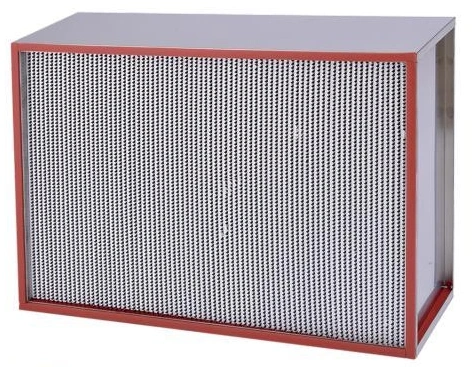
Air Filters
High-Temperature HEPA Filters
| Specification | High-temperature configuration |
|---|---|
| Filter construction | Pleated high-temperature filter assembly |
| Particle-control stage | HEPA filtration |
| Frame and seal | Selected for the specified thermal duty |
| Dimensions | Matched to the process filter housing |
| Temperature duty | Specified by continuous temperature, peak temperature and cycle |
| Installation | Compatible high-temperature housing and retention arrangement |
Dimensions and configurations can be customized for your application.
High-temperature HEPA filters combine fine-particle filtration with an assembly designed for a defined heated-air duty. Media, frame, separators and sealing materials must work together through the process temperature cycle.
Heat changes the whole filter assembly
Hot air affects more than the filter media. Frames expand, seal materials change behaviour and repeated heating and cooling load the joints between components. A suitable high-temperature filter therefore needs an assembly matched to the actual process rather than a conventional filter placed in a hotter location.
The useful selection information includes continuous operating temperature, short peaks, heating and cooling rates and how often the process cycles. Two installations with the same maximum temperature can place very different demands on the filter if one runs steadily and the other starts and stops frequently.
Protect the seal through thermal movement
Air that escapes around the frame has not passed through the filter media. The housing seat, retaining pressure and thermal movement allowance must therefore be considered together. Excessive restraint can distort an assembly as it heats; insufficient retention can allow an ineffective seal.
Use the mounting and conditioning procedure for the selected assembly. A new filter may require a controlled first heating cycle, and any such requirement should be incorporated into commissioning rather than left to an operator to discover during production. Do not apply the start-up procedure of an unrelated filter simply because it is also described as heat resistant.
Match the filter to the process air
Particle load
Identify where dust is generated and whether an upstream stage can reduce the load. Heavy process debris reaching the final filter can shorten useful operation and complicate changeout.
Moisture and chemicals
Include vapours, condensate during cooldown and cleaning chemicals in the selection. Temperature compatibility alone does not establish chemical compatibility.
Operating airflow
Set the duty with the process air conditions and available pressure in mind. The fan and control system need to support the required flow as the filter resistance changes.
Make inspection and replacement practical
Provide a removal route that allows the assembly to leave the housing without bending or striking the media. The service arrangement should allow the process to reach a suitable maintenance condition before personnel access the filter. Check the seating surface when changing filters; a damaged seat can undermine the new element immediately.
Where the process requires installed filtration verification, agree the test method and operating state before commissioning. A component description does not by itself demonstrate performance after installation. Dimensions, frame, seal system and thermal-duty selection can be customized for the application. Discuss the process temperature cycle.