Air Filters
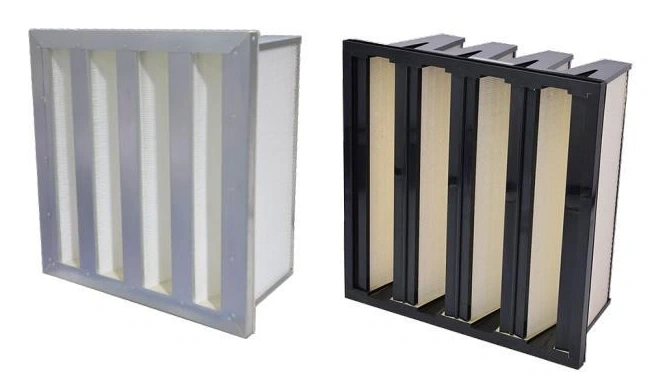
High Airflow V-Bank Filters
| Specification | V-bank configuration |
|---|---|
| Media arrangement | Multiple pleated panels in a V-bank frame |
| Application | Air-handling and ventilation filter sections |
| Frame arrangement | Rigid compact bank |
| Dimensions | Matched to the filter rack and available depth |
| Filter grade | Selected to the particulate-control requirement |
| Airflow selection | Matched to the required duty and available fan pressure |
Dimensions and configurations can be customized for your application.
A V-bank filter arranges multiple media panels within a rigid frame. The format provides extended filtration area without requiring a larger front opening, making it useful when an air-handling system needs greater media capacity within an existing filter section.
More media behind the same face opening
Raising ventilation flow through an existing filter can create excessive resistance, increase noise or reduce the air that actually reaches the rooms. A V-bank arrangement folds the filtration area into a deeper assembly. Air is distributed across several panels rather than being forced through one flat media surface.
The result depends on the selected media, bank geometry and operating point. A V-shaped frame alone does not establish efficiency or airflow capacity. Select the filtration grade and duty together, using the pressure-drop information for the actual filter being supplied.
Make the filter fit the air-handling system
The front frame must fit the rack, but depth is equally important. Check the space behind the filter, the distance to adjacent coils or fan inlets and the route through the service door. A filter that can be installed but cannot later be removed intact creates an avoidable maintenance problem.
Air should approach the bank without a concentrated jet aimed at only one section. Obstructions immediately upstream can overload one panel while leaving another lightly used. Correcting the approach flow can be more useful than replacing the filter with a larger nominal capacity.
Keep bypass out of the comparison
A high-performing media cannot compensate for gaps around its frame. The rack, gasket and retaining mechanism should hold the filter evenly against its sealing surface. Check compatibility before changing frame types in an existing installation, particularly where the previous unit used a different flange or sealing arrangement.
Compare useful operating capacity
Initial duty
Confirm that the selected bank passes the required air volume with pressure available for the rest of the system. Compare filters at the same duty rather than comparing unrelated maximum-flow figures.
Loaded duty
Allow for increasing resistance as dust accumulates. A fan that only meets the room demand with a new filter can leave the system short of air before the next scheduled replacement.
Service condition
Keep upstream particulate protection appropriate to the dust load and inspect the seal during changeout. Damaged frames or distorted banks should be addressed rather than hidden by extra clamping pressure.
Define the replacement before ordering
For an existing installation, identify the opening, depth, sealing face, target filter grade and duty airflow. For a new system, coordinate these details with the housing and fan selection. Housing dimensions, media selection and bank configuration can be customized to the application. Discuss the required filter configuration.